The Constellations
A yearly journey through the Mazzaroth — the twelve signs that, since the dawn of creation, have declared the glory of God and the story of His Son. We walk them in their ancient narrative order, one chapter each month, while the sky above turns to its own seasonal rhythm.
What We Mean by Mazzaroth
To wonder well, it helps to hold three things apart — and then let them speak together. Each one is a gift; confusing them only blurs the wonder.
The Word Mazzaroth
Mazzaroth appears only once in all of Scripture — in the Lord’s answer to Job out of the whirlwind: "Can you lead forth the Mazzaroth in their season?" (Job 38:32). A related form, Mazzaloth, surfaces in 2 Kings 23:5. Scholars trace the term to an Akkadian root, manzaltu — "a station" — and understand it as the constellations or the signs that mark the sun’s yearly path through the heavens. Scripture borrows the word without endorsing the myths the nations tied to it; it simply names those lights as God’s handiwork, set in their courses by His decree. In plain terms: this is what you see when you step outside at night and watch the twelve signs rise, one after another, across the turning year — the same sequence everywhere, opening at the spring equinox, the beginning of the biblical year. Modern astronomy explains that circuit as the earth’s orbit around the sun; the ancients simply described what the eye beheld. Both are the same road, seen from two vantage points.
The Sky That Actually Moves
Beneath every name and story is a sky that turns. As the earth circles the sun, the constellations along the ecliptic rise and set in a steady annual rhythm — the same sequence everywhere on earth, though your latitude decides how high each one climbs and whether a few ever clear your horizon at all. This layer needs no theology to be marveled at. It is the faithful clockwork of creation, the very circuit Genesis names when it says God made the lights "for signs and for seasons and for days and years" (Genesis 1:14).
The Gospel in the Stars
In the nineteenth century, Frances Rolleston and, after her, Joseph Seiss proposed that the twelve signs, read in sequence from Virgo to Leo, tell a single redemptive story — the Seed of the woman, the price paid, the enemy crushed, the people gathered, the conquering Lion. It is a beautiful and reverent reading, and many have found the Lord Jesus freshly in the night sky through it. But it is a theological proposal of that era, not a tradition we can trace back to ancient Israel or the early church. We hold it with gratitude — and with the honesty that the stars preach Christ most surely where Scripture interprets them.
"Can you bind the chains of the Pleiades or loose the cords of Orion? Can you lead forth the Mazzaroth in their season, or can you guide the Bear with its children? Do you know the ordinances of the heavens? Can you establish their rule on the earth?"
So we come to the constellations with both wonder and humility. The heavens are real, and they really turn. The biblical word for them is rare and precious. And the gospel story many of us learned to trace across them is a later, faithful reading — one we can treasure without claiming the ancients saw it just as we do. What follows holds all three layers together, letting each one speak in its own voice.
None of this is astrology. The Mazzaroth are not private messages about you; they are a public witness to Christ, held up for the whole world to read together. We reject every form of horoscope, personal future-telling, and zodiac personality-typing, and the ancient belief that the stars steer human destiny. The stars are creations; God alone is the Sovereign Ruler. We look to the Maker, never to what He made, for our lives and our days.
"There shall not be found among you anyone who… practices divination or tells fortunes or interprets omens… For whoever does these things is an abomination to the Lord." — "You are wearied with your many counsels; let the astrologers stand forth… they are like stubble; the fire consumes them."
If you have come here looking for a reading about yourself, you will not find one. The sky is not a mirror; it is a window. And the One it opens onto does not deal in horoscopes — only in mercy, justice, and the slow, sure redemption of all who turn to Him.
Read the Full GuardrailsWatch: the oldest story ever written across the night sky
The Biblical Calendar View
The story need not begin in January. The heavens themselves suggest a different starting point: the spring equinox, when day and night are balanced and the sky turns to new life. This is the solar new year reflected in the ancient calendar of Enoch — a clean, equinox-anchored scheme honored by serious people who took the heavens seriously — and in the biblical religious new year itself, when the Lord told Israel, “This month shall be for you the beginning of months” (Exodus 12:2). The early church quoted Enoch with respect; Jude treats his prophecy as true. Whatever its canonical status, his astronomy was prized by those who watched the sky for the glory of God.
Here we read the Virgo–to–Leo narrative in its ancient order, each chapter opening at the spring turning and walking through the solar year. For every sign we mark three things: when its chapter opens in this reading, when the sun actually passes through it, and when you can truly see it in the evening sky. The point is not to force a single correspondence, but to let the story and the sky and the feasts breathe together — all pointing to the glory of God in Christ.
“This month shall be for you the beginning of months. It shall be the first month of the year for you. Tell all the congregation of Israel that on the tenth day of this month every man shall take a lamb…”
When the sun passes through Aries each spring, Israel was commanded to take a lamb. The very month the sky proclaims the Ram is the month the Lamb of God was slain. The spring-anchor and the Passover-Lamb meet in the same sign, the same season, the same redemption. And in the spring evening sky, the story’s first sign, Virgo, rises in the east while its last sign, Leo, sets in the west — the narrative’s Alpha and Omega visible at once, the whole gospel held up overhead in a single night.
This is the heart of it: one story, from the Seed of the woman to the roar of the Lion, told by a sky that turns on the same spring hinge the Scriptures do — and all of it pointing, as the heavens always have, to the glory of God in the face of Jesus Christ.
Read the Lamb’s StoryThe constellations were not invented by a single poet or pasted onto the sky at random. They are older than history itself — and the striking thing is that nearly every ancient people, scattered across the globe, drew the same figures from the same stars. The Hebrews called the twelve signs along the sun's path the Mazzaroth; when God answered Job out of the whirlwind, He spoke of them as though Job already knew them by heart.
The Greeks later wrote the pictures down and draped them with their own myths; modern astronomers fixed the official count at eighty-eight. But underneath all the layers, the twelve signs sit in a fixed order along a single road — and they seem to be telling something. There is a story here, older than any of the nations that preserved it. What is it?
Read: How the Stars Were NamedEvery Sign Carries a Picture
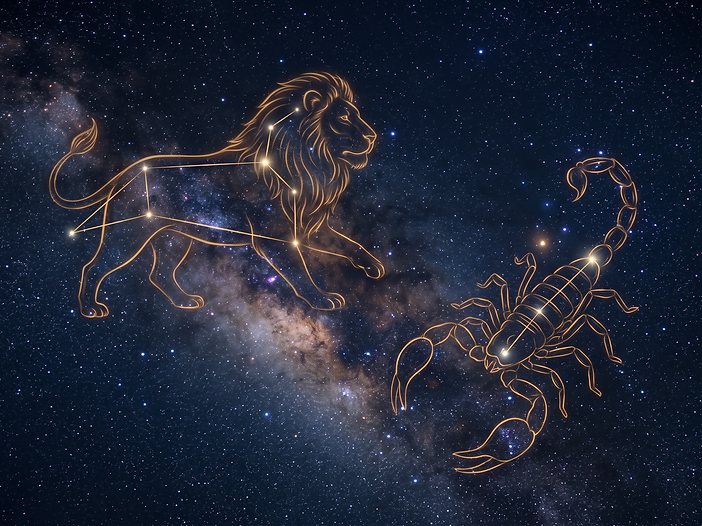
From the beginning, the same figures were read from the same stars by peoples who never met — a lion, a scorpion, a maiden, a bull. The heavens did not give us scattered points; they gave us a story in pictures, and each sign still carries its figure beneath the stars.


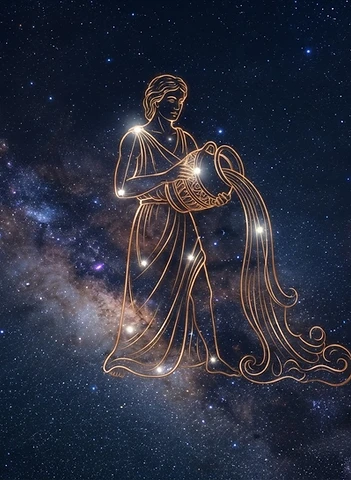
Aquarius
The Outpouring
An eternal figure pours living water without end — the outpoured Spirit for all who thirst.
Read the Full Story"This month" means the sign is at its best sometime during the month — not that it's visible every moment. If you step outside and can't find it, it's almost always a timing question rather than a permanent absence.
- · The sky turns through the night — a sign might be up at 2 a.m. but below the horizon at 9 p.m. Try a few hours later.
- · If it sits near the sun in the sky, it rises and sets in daylight and is lost in the glare. Each sign has a window of weeks when it's well-placed after dark — and a window when it isn't.
- · A low-hanging sign can be swallowed by trees, hills, or horizon glow even when technically above the line.
- · Only for the most northern or southern signs, from high latitudes, is it truly out of reach — permanently below the horizon.
So don't despair: usually it's a matter of waiting for the right hour of night, or the right week of the season.
The order of the signs never changes — the Mazzaroth sequence is fixed by the sun's yearly path through the heavens, the same everywhere on Earth. But where you live shapes what you actually see.
- · Some signs rise too far north or south to be visible from your latitude — the further you live from the equator, the more of one hemisphere's sky stays forever below your horizon.
- · A constellation that arcs high overhead in the tropics may hug the horizon — or never appear at all — near the poles.
- · Its figure may look tilted or upside-down depending on your hemisphere; "up" in the sky is not the same everywhere.
So the story is universal, but the view is local. The months below mark when each sign climbs highest — the same sequence worldwide, give or take a few weeks with latitude.
"The Mazzaroth tells the story. The rest of the heavens display the Storyteller."
When God answered Job, He pointed past the twelve signs — to Orion, the Pleiades, the Bear, and the chambers of the south. None of them are on the zodiac's path. Each one displays something distinct about the glory of the One who made them.
Explore: Beyond the MazzarothHere is the wonder of the Mazzaroth: the heavens do not hand out private readings. They publish one public witness for all of humanity, together, at once. Whether you stand in Nairobi or New York, the same constellations turn overhead in the same ancient order — a single story held up for the whole world to read, not a private label assigned to you.
That raises a fair question. If the sky gives everyone the same signs, why does the world insist on calling you a Leo because you were born in August? The answer reveals the whole difference between the Mazzaroth and astrology — and it comes down to day and night.
Astrology does not assign your “sign” by what is visible overhead. It assigns it by where the sun was sitting among the stars on the day you were born. In August the sun is in Leo’s region — which means Leo was up during the day, blazing behind the sun, drowned in its glare. You could not see it. The very sign astrology stapled to your identity was the one you could not see on the night you drew your first breath — a hidden, daytime star, called your destiny.
The Mazzaroth points the other way entirely. It is not about you, and it was never about your birth month. It is a public witness to Christ, walked in the ancient story order from Virgo to Leo — the Seed, the price, the conflict, the gathering, the conquering Lion. Which sign is most prominent in the evening sky in a given month is a separate and wonderful question of the seasons, answered in the “When to Look Up” note on each page. But what the heavens declare, they declare to everyone, and they declare one Person.
Two opposite ways to read the same sky
Astrology’s label
A hidden daytime star — the sun’s spot on your birthday
Used to define you. Invisible when you were born. Private.
The Mazzaroth’s witness
The whole sequence — a public story of Christ, in narrative order
Not about you. About Him. For the whole world to read.
So the next time someone calls you a Leo, let it be a reminder rather than a label. The sign they mean was the one you couldn’t see — up in the daylight, lost in the sun. The heavens were never assigning you to a star; they were assigning every star to Him, and telling one story to the whole world at once. One voice whispers your destiny from a sign you can’t see; the other proclaims His glory from a sky you can.
We are not assigned to the sky. The sky is assigned to Him — and to the whole world, together.
A Celestial Calendar
Twelve chapters. One unbroken story — from the promise of a Seed to the roar of a conquering Lion. The cycle opens at the spring equinox, the beginning of the biblical year, and each sign headlines its chapter as it first rises into the evening sky.