The Moon
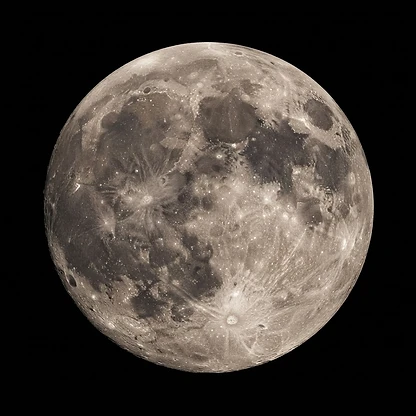
"The lesser light to govern the night" (Genesis 1:16). The moon makes no light of its own — it only reflects the sun, a quiet picture of the people of God, who shine not from themselves but from the One they face. "He made the moon to mark the seasons, and the sun knows when to go down" (Psalm 104:19). Greater and lesser, both keep their appointed rounds.
The Witness That Has No Light of Its Own
Step outside on a night the moon is full and you can almost read by it. Yet the moon produces no light at all. Every photon that reaches your eye began at the sun. The moon is only a mirror — the most faithful reflector in our sky.
This is exactly how Scripture describes the people of God. They are not the source of the light they carry; they are the ones who keep turning their face toward the One who is. "You are the light of the world" (Matthew 5:14) — not because you generate the light, but because, like the moon, you are placed where it can fall on you.
The moon is faithful because it never tries to shine on its own. It simply holds its place. So too the witness of God's people: their brightness is borrowed, and their faithfulness is in not turning away.
And God made the two great lights… the lesser light to govern the night.
Why the Moon Matters More Than It Looks
The moon looks small, but it is doing enormous work. Its gravity pulls the oceans into tides — the slow, faithful breathing of the sea. Without the moon, the earth's axis would wobble chaotically over the centuries, and the seasons that Genesis promises would drift away. The moon holds the world steady.
A large, well-placed moon is also rare. From the earth, the moon appears almost exactly the same size as the sun — which is why total eclipses are possible. The moon is 400 times smaller than the sun and 400 times closer. That quiet coincidence lets the sky perform one of its most awe-filled sermons: the two great lights, one covering the other for a breathless moment, and then passing.
And the moon is slowly, slowly receding — about an inch and a half farther from the earth each year. It is the only moon in our sky large enough to produce a total solar eclipse right now. The heavens are not static; they are a precise, moving clock, and we are alive in the particular moment when the lesser light perfectly matches the greater.
He made the moon to mark the seasons; the sun knows its going down.
The Sky's Oldest Clock
The moon is the most faithful timekeeper in the ancient sky. Long before calendars, people marked months by the cycle of its face — new, waxing, full, waning, gone, and born again. "He made the moon for seasons" the psalmist says, because the moon was the visible rhythm by which the festivals of God's people were set.
God called the moon "a faithful witness in the sky" (Psalm 89:37) — and tied it to a promise. As long as the moon keeps its cycle, David's throne will stand. The witness in the sky is the guarantee of a covenant on the earth.
A faithful witness does not need to be bright. It only needs to be dependable. The moon shows up, every twenty-nine days, exactly as it was made to. In a world of broken promises, there is something steadying about a light that never misses its appointment.
Like the moon it shall be established forever, a faithful witness in the skies.
A World That Reflects the Sun of Righteousness
If the sun is a picture of Christ — the Sun of Righteousness — then the moon is a picture of the people He is preparing for Himself: a bride with no light of her own, made luminous only by looking at Him. "The marriage of the Lamb has come, and his Bride has made herself ready" (Revelation 19:7).
One day the lesser light will not be needed either. "The night will be no more. They will need no light of lamp or sun, for the Lord God will be their light" (Revelation 22:5). Until then, the moon keeps its vigil every night — a quiet reminder that the faithful One who hangs the stars also steadies the seasons of a single life.