The Breath
of God
You cannot see the wind. You can only see what it moves. And Scripture says the same is true of the Spirit of God — invisible, uncontained, yet carrying every leaf and every life toward the One who sums up all things.
A Voice Without a Body
Long before weather satellites named the jet streams, the Word of God had already named the wind's secret. The wind is not merely air in motion. In Hebrew the same word — ruach — means breath, wind, and spirit. The breath you feel on your face and the Spirit who hovered over the waters are, in the Bible's vocabulary, one mystery.
When Jesus stood at the temple on the last great day of the feast, He took that mystery in His hands and pointed it at a person. He said the Spirit of God moves the way the wind moves — free, unseen, and unmistakable.
The wind blows where it wishes, and you hear its sound, but you do not know where it comes from or where it goes. So it is with everyone who is born of the Spirit.
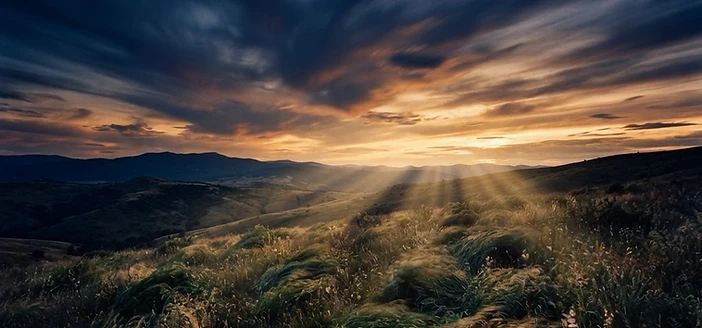
Notice the gentleness and the awe. He does not explain the wind. He simply tells us to listen. The same wind that bends the tall grass is the same kind of motion that bends a human heart toward God.
The Lord's Chariot of Air
From the very first lines of Scripture, the Spirit rides the wind. He hovered — moved, brooded — over the face of the unformed deep. And the Psalms keep the image: God makes the winds His messengers, His chariots ride the wings of the storm.
The earth was without form and void, and darkness was over the face of the deep. And the Spirit of God was hovering over the face of the waters.
He makes the clouds his chariot; he walks on the wings of the wind; he makes his messengers winds, his ministers a flaming fire.
He rode on a cherub, and flew; he came swiftly on the wings of the wind.
The sky is not an empty hall. It is a highway. When the wind moves, something — or Someone — is moving on it.
What the Wind Reveals About the Spirit
Hold the wind and the Spirit side by side — the sky above and the Breath of God who moved over the waters — and the likeness is almost too plain to miss. The wind is not the Spirit, but it is His oldest portrait.
You cannot see the wind — only what it moves.
You cannot see the Spirit — only the life He gives and the works He does.
It blows where it wills; no one commands it.
He moves where He wills; no one captures Him or corners His grace.
It carries sound across the world, yet makes no sound of its own.
He carries the word of God, yet speaks only what the Father gives.
It lifts the clouds, turns the seasons, and fills the sails.
He lifts the heart, turns the soul, and fills the church with power.
Every breeze that stirs the leaves is a small sermon. Every gale that bends the oak is a louder one. The wind preaches an invisible God who is nevertheless at work in every visible thing.
The Wind That Filled the Dry Bones
Ezekiel stood in a valley of death and saw a vision the whole church still leans on. Dry bones, scattered and hopeless. And the Lord asked the prophet a question — can these bones live? Then He answered it with a wind.
Then he said to me, “Prophesy to the breath; prophesy, son of man, and say to the breath, Thus says the Lord GOD: Come from the four winds, O breath, and breathe on these slain, that they may live.” So I prophesied as he commanded me, and the breath came into them, and they lived and stood on their feet, an exceedingly great army.
And suddenly there came from heaven a sound like a mighty rushing wind, and it filled the entire house where they were sitting… And they were all filled with the Holy Spirit.
The wind that raised the bones is the same wind that filled the upper room. When the Spirit comes, He comes like wind — invisible, undeniable, and able to make dead things stand up and live.
The Ancients Saw an Order
Long before the scientist charted the pressure systems, the ancient seer of Enoch was shown the four winds of heaven — held, measured, and sent out from treasuries. We read Enoch not as Scripture but as an old witness — yet the early church revered his writing and quoted it, sharing his worldview — Peter and Jude both quote directly from him. The same heavens the prophets called God's glory were understood even then as ordered and governed, never left to chance.
And from there I went toward the east, into the midst of the mountain of the desert, and I saw a place… and there I saw three portals of heaven open in the east… from these come the winds of the east, and of the west, and of the north, and of the south.
Revered & Quoted by the Early Church — Peter & Jude Quote Him — Not Western Scripture
And at the ends of the earth I saw twelve portals open for all the winds, from which they go forth and blow over the earth. Three portals are open in the heaven… and through their portals the winds go forth, and bring the moisture of the sea and of the land.
Revered & Quoted by the Early Church — Peter & Jude Quote Him — Not Western Scripture
The ancients looked up and saw not chaos but a household — winds kept in storehouses, opened and shut by appointed order. The breath on your face today is part of a measured economy older than the mountains.
He Sums Up Every Breeze
The Bible will not let the wind be a metaphor alone. The New Testament tells us that all things — visible and invisible, winds and spirits and thrones — were made through Him and for Him. The wind itself is held together, directed, and summed up in a person: Christ.
For by him all things were created, in heaven and on earth, visible and invisible, whether thrones or dominions or rulers or authorities — all things were created through him and for him. And he is before all things, and in him all things hold together.
Making known to us the mystery of his will, according to his purpose, which he set forth in Christ as a plan for the fullness of time, to unite all things in him, things in heaven and things on earth.
So the wind does not merely point to the Spirit in a general way. It points to the Christ who, by the Spirit, holds every breeze and every breath together. The wind you cannot see is carried by the One who became visible for us — and who now, by that same Spirit, sums up all things.
The Wind That Still Moves the Church
On the evening of the resurrection, Jesus did something the whole church still leans on. He breathed. The same Breath that was over the waters in Genesis now stood in a room in John and gave His Spirit to His own.
And when he had said this, he breathed on them and said to them, “Receive the Holy Spirit.”
Every gust that turns a windmill, every breath that fills a lung, every revival that stirs a sleeping church — all of it is caught up in that one breathing. The wind has a destination, and the destination is Christ: forming a bride, filling a body, gathering all things into one.
When Fear Became Fire
Pentecost was not a gentle event. The same Spirit who once hovered over the waters came back — and this time He came with a sound. Not a whisper. A roar. A mighty, rushing wind that filled the whole house.
And the men it fell on were not the men they had been ten days before. Fifty days earlier, they had run. Peter had sworn he never knew Him. All of them, save John, had vanished when it mattered most. They were men of fear behind locked doors.
On the evening of that day, the first day of the week, the doors being locked where the disciples were for fear of the Jews, Jesus came and stood among them.
Then the wind came. And the same Peter who once cursed beside a charcoal fire stood up in the very city that killed his Lord and preached with such boldness that three thousand were cut to the heart in a single morning. The wind had not changed the message. It had changed the messengers. Fearful men became heralds — because the Breath of God filled their lungs.
And when they had prayed, the place in which they were gathered together was shaken, and they were all filled with the Holy Spirit and continued to speak the word of God with boldness.
This is what the wind does. It does not make us louder about ourselves; it makes us courageous about Him. The same breath that made Adam live now makes disciples brave.
The Wind That Moved the Early Church
The wind did not stop at Pentecost. It kept blowing, and where it blew, the impossible kept happening. The early church was a community carried by a current it could not see.
The lame walked at a gate. Shadows carried healing as Peter passed. Prison doors opened by themselves while the church prayed all night. A persecutor named Saul was knocked to the ground and turned into the apostle who would carry the gospel to the ends of the earth. None of it was strategy. All of it was wind.
So that they even carried out the sick into the streets and laid them on cots and mats, that as Peter came by at least his shadow might fall on some of them. The people also gathered from the towns around Jerusalem, bringing the sick and those afflicted with unclean spirits, and they were all healed.
So Peter was kept in prison, but earnest prayer for him was made to God by the church… And behold, an angel of the Lord stood next to him, and a light shone in the cell. And he struck Peter on the side and woke him, saying, “Get up quickly.” And his chains fell off his hands.
Read those chapters slowly and a pattern emerges. The apostles did not engineer the mighty works. They were caught up in them. They prayed, the wind blew, and the world shook. The church did not advance by the strength of its arguments but by the power of a Breath that still had not stopped moving.
A Witness From Our Own Day
And here is the wonder the church needs to recover: that wind never stopped. It did not belong to the first century. It did not exhaust itself in the upper room. The same Spirit who hovered over the deep, who filled the dry bones, who shook the house at Pentecost, has never left the earth.
In 1965, on the island of Timor, a young evangelist named Mel Tari lived through something that echoed the book of Acts. After a season of prayer and fasting, the gospel spread across the island with signs following — the sick healed, the blind seeing, water turned to wine, and even storms commanded in the name of Jesus, just as He had once calmed the sea. Tari recorded it all in a small book with a telling title: Like a Mighty Wind.
We hold such testimonies carefully, testing them by the Word and never putting experience above Scripture. Yet they echo a promise Christ Himself gave before He ascended — that the works He did, His church would do also, and greater things still, because He was going to the Father and sending the wind.
Truly, truly, I say to you, whoever believes in me will also do the works that I do; and greater works than these will he do, because I am going to the Father. Whatever you ask in my name, this I will do, that the Father may be glorified in the Son.
And in the last days it shall be, God declares, that I will pour out my Spirit on all flesh, and your sons and your daughters shall prophesy, and your young men shall see visions, and your old men shall dream dreams.
The promise did not expire. The wind is not a memory. The Spirit who changed frightened disciples into heralds in Jerusalem is the same Spirit who still falls on hungry, praying churches today — in Timor, in Africa, in quiet rooms where two or three ask in faith. The question is not whether the wind still blows. It is whether we will open the door of our lives and let it in.
When the Wind Fell on the Campuses
If the wind of Acts 2 truly never stopped, we should not be surprised when it blows again — and in our own day it has blown, unmistakably, across a generation the church had nearly given up on.
On a Wednesday morning in February 2023, at a small Christian college in Wilmore, Kentucky, a routine chapel service simply did not end. The students stayed. No one dismissed them. No one programmed what came next. They just kept singing, kept confessing, kept kneeling — and the doors of Hughes Auditorium stayed open, day and night, for weeks. Tens of thousands traveled to a tiny town to sit in the overflow of something no committee had organized. It was, by every honest account, an outpouring. They called it the Asbury Revival.
And in the last days it shall be, God declares, that I will pour out my Spirit on all flesh, and your young men shall see visions, and your old men shall dream dreams.
And Asbury was not alone. The wind did not stop at the Kentucky line. At The Ohio State University, a football team declared it the year of "Jesus Won," and on a single night hundreds of students walked forward to be baptized in front of their peers. At the University of Oklahoma, nine thousand students filled a basketball arena not for a game but to seek God. At East Carolina, the wind reached into fraternity houses. On campus after campus, a generation raised on screens and starved for the real began to weep, repent, and worship — face to face, unscripted, and unembarrassed.
Your people will offer themselves freely on the day of your power, in holy garments; from the womb of the morning, the dew of your youth will be yours.
What is striking is how much the campus awakenings resemble the first Pentecost and how little they resemble our engineered age. There was no headline speaker, no production, no app that made it happen. There was hunger, prayer, and a Breath that no one commanded. The rising generation did not invent the wind — they were simply the ones who, for a season, stopped fighting it and let it fill the room. The wind, it turns out, does not need a platform. It needs an open door.
Read alongside the older testimonies — Timor, the Hebrides, the great awakenings of centuries past — the campus movement is one more stitch in an unbroken line of prayer for America. From the upper room to a chapel in Wilmore to a stadium in Columbus, the same Breath has been drawing one continuous thread through the dark. The line has never snapped. It only waits for the next willing heart to take hold of it.
Behold, I send my messenger, and he will prepare the way before me. And the Lord whom you seek will suddenly come to his temple.
We hold such days carefully. The wind that fell on the campuses was not a movement to be branded or a bandwagon to be joined — it was a mercy to be received. Revivals do not replace the preached Word; they return us to it. They do not make us experts in the spectacular; they make us humble before the ordinary means of grace — prayer, repentance, the open Bible, the gathered church. And they always, always, point beyond themselves to the Christ who sends the wind and not to the wind itself.
Wonder, Not Divination
Scripture is careful. The wind reveals God's glory and power — it does not predict our fortunes. To read the winds for omens is to turn wonder into idolatry. We watch the wind to worship, never to divine. The wind is a witness of the Spirit, not a crystal ball of our fate.
As you do not know the way the spirit comes to the bones in the womb of a woman with child, so you do not know the work of God who makes everything.
This is the boundary of our wonder: we observe the wind with grateful eyes; we do not consult it as an oracle. Every breeze is an arrow — and the arrow always points to the invisible God, known at last in the visible Christ.
The next time a breeze turns your face, pause. You cannot see the one who made it — but neither can you see the Spirit who moved over the deep, who breathed on the disciples, who rides every wind today. The wind was never empty. It is the breath of a God who is drawing all things, through His Son, into one.
Behold the One Who Sums Up All Things Back to the Journey