Sunrise
& Sunset
The day has two bookends, and both of them burn. No telescope is needed, no app required — only a horizon and the patience to stand still. Here is how to read the day's oldest sermon, and why it never stops preaching.

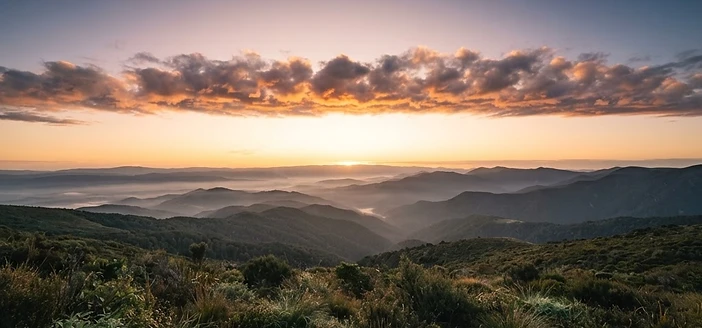
A Show With No Admission
Sunrise and sunset are the most faithful events in the sky. They happen every single day, without exception, without ticket or telescope — and they cost nothing but a few quiet minutes. While the rest of the heavens move on their own slower clocks, dawn and dusk keep daily time with us, marking our waking and our rest.
The psalmist saw the whole day as a single, continuous song — morning and evening as two verses of the same stanza, both of them shouting for joy.
You make the going out of the morning and the evening to shout for joy.
To learn to watch them is to recover a rhythm older than any screen: the day begins in light given, and ends in light gathered back. This page is a small guide to that watching — what to look for, when to look, and what the colors are quietly saying.
The Physics of the Color
Sunlight is white because it carries every color at once. But the atmosphere is full of air molecules that scatter the shorter, bluer wavelengths sideways — that is why the daytime sky is blue. When the sun sits low, its light has to travel through a much thicker slice of air to reach your eye, and almost all the blue gets scattered away before it arrives. What is left is the long, warm red and orange light — the color of the sun filtered through miles of sky.
The more air and particles the light has to pass through, the deeper the color. A clear, dry sky gives soft pastels; a sky with a little dust, smoke, or humidity gives the blazing crimson and amber that photographers chase. This is why dawns are often gentler and cooler than sunsets — the air at sunrise has settled clean overnight — and why a sunset after a summer storm can set the whole west on fire.
Nothing in this is random to the believer. The same God who set the sun in the sky filled the air with the very particles that turn its rising and setting into color. He could have made the day begin and end in a flat gray. He did not.
Twilight, Hour by Hour
The show is not the single instant the sun crosses the horizon. It is a slow hour on either side, broken into phases by how far the sun sits below the line. Knowing them tells you exactly when to arrive and how long to stay.
~20 min before & after the horizon crossing
The sun sits low; light is warm, long, and soft. The richest color of the whole day.
Sun 0° to −6°
The horizon is still clearly drawn; brightest planets (Venus, Jupiter) appear. No stars yet.
Sun −6° to −12°
The horizon becomes a silhouette; the sky turns deep blue. The brighter stars emerge.
Sun −12° to −18°
The sky goes fully dark to the eye. Faint stars and the Milky Way become visible.
The practical rhythm is simple: arrive about twenty minutes before the horizon crossing, and stay twenty minutes after. The most photographed instant is the sun touching the line — but the deepest color and the first stars come in the twilight that follows. The faithful viewer waits.
Direction, Season, and Latitude
The sun does not rise and set in the same place every day. Its rising and setting points drift along the eastern and western horizons across the year, walking north through the spring and summer and south through the autumn and winter.
Summer Solstice
Rises NE · Sets NW
Longest arc, longest days, shortest twilight show.
Equinoxes (Mar / Sep)
Rises due E · Sets due W
Equal day and night; the sun crosses straight across.
Winter Solstice
Rises SE · Sets SW
Lowest, shortest arc; long, lingering twilights.
Two more notes for the watcher. First, the farther you live from the equator, the more the sun's rising and setting points swing — and the longer the twilight stretches, giving you more time in the color. Near the equator the day flips to night almost like a switch. Second, turn around. The most overlooked sight at sunrise and sunset is the opposite horizon: a soft pink band called the Belt of Venus, riding above the Earth's own shadow as it rises or falls. Half the sermon is behind you.
Mercies That Come With the Dawn
Now the watching turns to worship. Every dawn the sky opens with color that was not there the night before — and Scripture says that is a picture of something even more faithful than the sun. The sun will one day be no more, but the mercy of God is new with every morning, without fail, without end.
The steadfast love of the Lord never ceases; his mercies never come to an end; they are new every morning; great is your faithfulness.
The darkest night in the Bible ends the same way — with morning. Sorrow may last for the night, but joy comes with the dawn. The sunrise is not a metaphor for hope; it is hope, rehearsed in fire, every day until the Day that has no sunset.
Weeping may tarry for the night, but joy comes with the morning.
When the Light Is Gathered Back
The sunset is the other half of the same sermon. Genesis measures the whole of creation in evenings and mornings — the day begins in rest and is carried into work by the light. When the sun goes down, the day is folded up and returned to its Maker, and the sky signs the receipt in color.
The sun arises, they shrink away and lie down in their dens. Man goes out to his work and to his labor until the evening.
There is a quiet invitation in every sunset: to stop. To let the work that was enough be enough. The evening does not ask for productivity; it asks for gratitude. The light that was given in the morning is gathered back at night, and the same God who lit the east will light it again tomorrow.

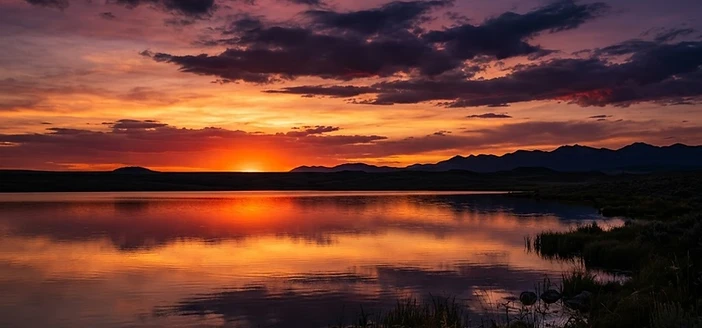
A Sky Without Need of the Sun
The gold and crimson of the horizon are not decoration. They are a parable the sky tells in a language older than words — that light is the native garment of creation, and that the source of all light is a Person. One day, Scripture says, the parable will be fulfilled and the picture will be replaced by its subject. There will be no need of sun or moon, because the glory of God will be the light, and the Lamb will be its lamp.
And the city has no need of sun or moon to shine on it, for the glory of God gives it light, and its lamp is the Lamb.
Until that day, every sunrise is a promise in miniature and every sunset is a rehearsal of rest. The fire in the sky is the handwriting of a Bridegroom who rose once from a tomb and is coming again — and who, in the meantime, paints the horizon every morning and every evening so we do not forget.
Watch the Show, Not the Sun
The boundary here is the same one given for every light in the sky. We let the sun preach, and we let it preach of Christ. The moment we bow to it, or read the times of its rising and setting as omens for our lives, we have crossed from wonder into the very thing Scripture forbids. The sun is a witness, not a god.
And beware lest you raise your eyes to heaven, and when you see the sun and the moon and the stars, all the host of heaven, you be drawn away and bow down to them and serve them.
Watch the color. Marvel at the science. Read the sermon. But keep your worship for the One the sunrise and sunset are pointing to. The show is free; the worship belongs to the Maker of the stage.
Tomorrow, twenty minutes before the horizon crossing, find a window to the east — and at day's end, a window to the west. Stand still. Let the sky do the talking. The faithfulness you are watching is older than the sun.
The Bridegroom of the Sky Back to the Journey