Lightning & Thunder
They are not angels bowling, and God is not moving His furniture. They are real, fearsome, and astonishing — and Scripture has been speaking through them since the first storm. Where they come from, and what God is saying through them.
A bolt of lightning is hotter than the surface of the sun. The thunder that follows is the air itself, torn apart and slamming back together. And both of them — the flash and the boom — are older than our stories about them. Before anyone spoke of angels bowling, the psalmist called the storm the voice of the Lord.
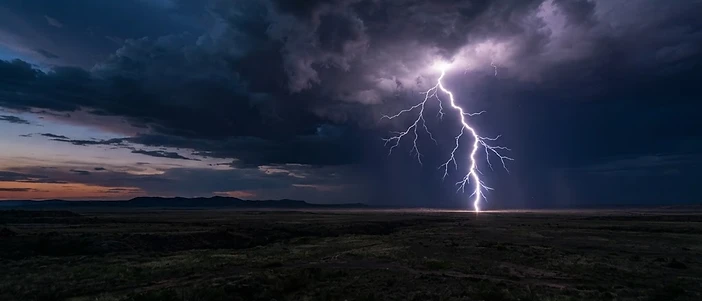
He covers His hands with the lightning — Job 36:32
The Real Source
The childhood stories are sweet. The truth is far more wonderful — and it is no less a reason to look up in awe.
A Field of Tension
Inside a storm cloud, warm air rushes upward and cold air sinks. As ice crystals and hailstones collide in the turbulence, they swap electrical charge — lighter ice shards rising with a positive charge, heavier hail falling with a negative one. The cloud becomes a giant battery suspended in the sky, the ground beneath it the opposite pole, and the air between them an insulator straining to hold.
The Strike
When the tension finally overcomes the air’s resistance, the insulator breaks down in a fraction of a millisecond. A stepped path of charge connects cloud to ground, and a return stroke rushes back up at about a third the speed of light — the blinding flash we call a bolt. A single bolt can carry a hundred million volts.
The Boom
That flash heats the air around it to roughly 30,000°C — about five times hotter than the surface of the sun. The superheated air explodes outward faster than sound can travel, and the shockwave we hear as thunder rolls outward for miles. The lightning makes the thunder; the light is the cause, the sound is the echo.
Why You See It First
Light reaches you almost instantly; sound crawls behind at roughly a thousand feet per second. Count the seconds between the flash and the boom — about five seconds to a mile — and you can measure how far away the storm truly is. The storm is always closer to your eyes than to your ears.
Sweet Pictures — and a Greater Wonder
What we heard growing up
Angels bowling
It is a fond picture, born of a culture that wanted to make thunder friendly for children. But the truth is grander than a heavenly game of tenpins. The same God who numbers the stars governs the charge of every raincloud — and chooses, in His wisdom, when the air will break.
What we heard growing up
God moving His furniture
We say it to shrink an awesome sound down to something domestic and small. But Scripture never reduces the thunder to a rearranged sofa. It calls it the voice of the Lord — and asks us to listen.
How Lightning Serves the Earth
The bolt that terrifies also feeds the field and sweetens the air. The same storm that shakes the cedar grows the wheat.
Nitrogen for the Fields
The air is mostly nitrogen, but plants cannot use it as it is. A lightning bolt’s immense heat splits that tough molecule apart, letting it bond with oxygen to form nitrates. Rain washes them down into the soil as natural fertilizer — roughly ten million tons of usable nitrogen worldwide every year. It is part of why the grass is so green after a storm.
A Whisper of Ozone
The same discharge also makes a little ozone — that sharp, clean "after-the-storm" smell. High in the atmosphere, ozone shields us from the sun’s ultraviolet light; near the ground it is a minor pollutant. So lightning’s ozone gift is real but small: more blessing than burden, and a faint reminder that the same fire that strikes also guards.
Washing the Sky
The storm that carries lightning also scrubs the air. Its rainfall gathers dust, pollen, smoke, and ash out of the sky and brings them to the ground, leaving the air literally cleaner to breathe. The thunderstorm that startles you is also doing the dishes for the atmosphere you live in.
“He waters the mountains from His upper chambers; the earth is satisfied with the fruit of Your work. He causes the grass to grow for the livestock.”
The Voice in the Storm
Lightning and thunder are not a sign of God’s annoyance. In Scripture they are the sound of His nearness, His power, and His care.
His Voice
Psalm 29 turns thunder into speech. Seven times it names “the voice of the Lord” — flashing lightning, shaking the wilderness, twisting oaks. The storm is not random noise; it is a sermon God has been preaching since the first thunderclap.
"The voice of the Lord is over the waters; the God of glory thunders, the Lord, over many waters. The voice of the Lord is powerful; the voice of the Lord is full of majesty."
His Aim
Elihu tells Job that God holds the bolt the way a warrior holds an arrow, and aims it where He wills. No lightning is aimless. Each one falls under command — not a stray accident, but a mark struck by the hand of the Almighty.
"He covers His hands with the lightning and commands it to strike the mark."
His Unsearchable Greatness
A single thunderstorm is only the edge — the hem — of what God can do. The loudest sound we can bear is, by His measure, a whisper. We have never heard the full volume of His power; we have only felt its outskirts.
"These are but the outskirts of His ways; and how small a whisper do we hear of Him! But the thunder of His power who can understand?"
His Presence
When John is given a glimpse of heaven, lightning is what the throne looks like. The same fire that splits a summer sky is the atmosphere of the presence of God — awesome and near, terrifying and beautiful at once.
"From the throne came flashes of lightning, and rumblings, and peals of thunder."
His Rescue
David sang that God used the storm like a weapon to deliver him. Lightning is not only majesty on display; it is God fighting for His own — the heavens themselves enlisted in the defense of the people He loves.
"The Lord thundered from heaven, and the Most High uttered His voice. And He sent out arrows and scattered them; lightning, and routed them."
His Tenderness
The storm that terrifies also waters the earth. Lightning even fixes nitrogen into the soil that feeds the fields. The same voice that shakes the cedar also grows the wheat. Wrath and mercy travel in the same cloud.
"He waters the mountains from His upper chambers; the earth is satisfied with the fruit of Your work. He causes the grass to grow for the livestock."
The next time the sky breaks open, do not reach for the old cartoons. Listen. The Lord is speaking — in power, in presence, and in a tenderness that waters the very earth it shakes.
The Voice of the Storm