The Lights
Go Dark
A total eclipse is the rarest rehearsal in nature — the lights that govern our days and nights stepping aside for a moment, then returning. Scripture takes such a darkening seriously: at the cross the sky turned black, and the prophets saw a sun clothed in sackcloth and a moon turned to blood. Eclipses do not announce our fortunes. They announce a creation that obeys its Maker — and a cosmos whose signs already point to the One who hung upon it.
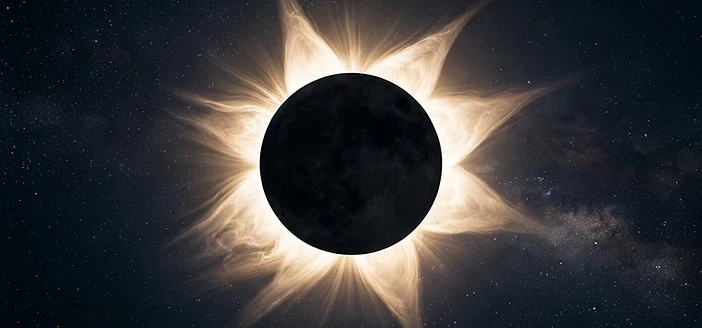
The Two Great Eclipses
An eclipse is simply one of the great lights passing through the shadow of another. The Moon drifts between us and the Sun and the day goes dark: a solar eclipse. Or the Earth steps between the Sun and the Moon, and the full Moon turns to copper: a lunar eclipse. The geometry is precise, the timing is ancient, and the sight of either is enough to silence a whole city.
What makes them so affecting is not the shadow itself but what the shadow reveals. In an ordinary day we cannot look at the Sun; in a total eclipse its hidden crown steps forward, pale and terrible and burning. The ordinary is veiled so the extraordinary can be seen. The heavens, it turns out, have always worked this way — the familiar passing away for a moment that the glory might appear.
The heavens declare the glory of God, and the sky above proclaims his handiwork. Day to day pours out speech, and night to night reveals knowledge.
When Day Becomes Dusk
A solar eclipse happens only at a new Moon, when the Moon is otherwise invisible against the Sun. Most months its shadow misses the Earth entirely; but now and again it falls across us, a small dark coin sliding across the face of the day. The path of totality is narrow — sometimes only a hundred miles wide — and within it, for a few minutes, the world holds its breath.
There are three kinds. Each is a different way of the Moon hiding the Sun:
The Moon fully covers the Sun, and day becomes dusk — the corona blazes forth, stars appear, and the air grows cold.
The Moon takes a bite from the Sun, leaving a crescent of daylight. Common, but never ordinary.
The Moon is too far to cover the Sun entirely, leaving a bright ring of fire around the shadow.
Only within the path of totality do the stars come out at noon, the corona blaze, and the air grow cold. It is one of the most awesome sights the sky offers — and it is fleeting, lasting at most seven and a half minutes before the light floods back.
When the Moon Turns to Blood
A lunar eclipse happens at the opposite season — at full Moon, when the Earth stands between the Sun and the Moon and casts its shadow across the lunar face. Unlike a solar eclipse, a lunar eclipse is seen by an entire hemisphere at once: anyone under a night sky when the Moon rises into the Earth's shadow can watch it.
In a total lunar eclipse the Moon does not disappear. It dims and reddens — the light of every sunrise and sunset on Earth bent around the planet and poured onto the Moon at once. The ancients called it a blood moon, and the name has never left:
The Moon passes fully into the Earth’s shadow and turns blood-red — visible to a whole hemisphere at once.
Only part of the Moon darkens, the rest still bathed in sunlight — a visible notch of shadow.
The Moon grazes the outer, faint shadow — a subtle dimming easily missed by the casual eye.
That reddening is the earth's own shadow, filtered through its own air. The Moon turns the color of blood by the light of a world that refused the Light — and it does so on a schedule so regular that the prophets could speak of it centuries beforehand.
The Saros Cycle
Eclipses are not random. The same geometry returns every eighteen years, eleven days, and eight hours — a pattern the Babylonians discovered and named the Saros. One Saros ends and another begins, each producing eclipses of the same character along the same family line. The heavens keep a calendar no human invented, and they keep it perfectly.
This is the testimony of a creation under order, not under chance. The lights were given for signs and seasons — and even their shadows run on time. The God who numbers the stars numbers their eclipses too, and not one of them catches Him by surprise.
And God said, Let there be lights in the expanse of the heavens to separate the day from the night. And let them be for signs and for seasons, and for days and years.
When the Sky Turned Black
Of all the darknesses ever to fall, one stands apart. On the afternoon Christ was crucified, the land went dark for three hours — not in the brief minutes of a natural eclipse, but for three hours, at noon, while the Son of God hung upon the cross. It was a darkness the heavens themselves seemed to keep.
It was now about the sixth hour, and there was darkness over the whole land until the ninth hour, while the sun's light failed. And the curtain of the temple was torn in two.
The sun's light failed. The natural world held its breath while its Maker died. Whatever astronomy may say of that afternoon, Scripture tells us the meaning: the sky went dark because the Light of the world was being put out, and the whole creation mourned its Lord.
The Sun in Sackcloth, the Moon in Blood
The prophets saw eclipses — and something greater than eclipses — as the language of the last days. The sun clothed in black, the moon turned to blood: the very lights of the sky bowing in witness to the day of the Lord. At Pentecost Peter reached for these words to explain the Spirit; in Revelation the same signs return when the sixth seal is opened.
And I will show wonders in the heavens and on the earth, blood and fire and columns of smoke. The sun shall be turned to darkness, and the moon to blood, before the great and awesome day of the LORD comes.
When he opened the sixth seal, I looked, and behold, there was a great earthquake, and the sun became black as sackcloth, the full moon became like blood.
Eclipses may be the sketch — but the final fulfillment will be more. On that day the lights will not merely pass through shadow; they will testify that the Judge of all the earth has come. And the question Joel asks is the question every eclipse quietly poses: are you ready for the Day?
Wonder, Not Omens
Scripture is careful. An eclipse reveals God's glory and His ordered creation — it does not predict your future, your fate, or your fortune. The nations have always read eclipses as omens of disaster, portents of kings falling, signs of doom. The people of God have always said otherwise: the heavens declare His glory, not our destinies. We watch an eclipse to worship, never to divine.
There shall not be found among you anyone who practices divination or tells fortunes or interprets omens. And because of these abominations the LORD your God is driving them out before you.
This is the boundary of our wonder: we let the darkness preach, and we let it preach of Christ. We do not read eclipses for omens, and we do not tremble at the sky as though it announced our doom. Every darkened sun and every blood-red moon is an arrow — and the arrow always points to the cross, to the King, and to the Day He will return.
The next time the lights go dark — the Sun swallowed by the Moon, the Moon reddened by the Earth's shadow — do not only see the wonder. See the witness. The heavens keep a calendar no human invented, and their shadows have always pointed to one afternoon when the sky turned black because the Light of the world was dying, and to one coming Day when the Sun of Righteousness will rise and never set again.
Behold the Light That Will Not Set Back to the Journey