The Eyes We Built
to See His Glory
In 1990 we carried a telescope above the atmosphere and pointed it at the dark. What came back was not empty space — it was a worship service, written in light, forty years in the telling. These are the pictures Hubble has been sending home.

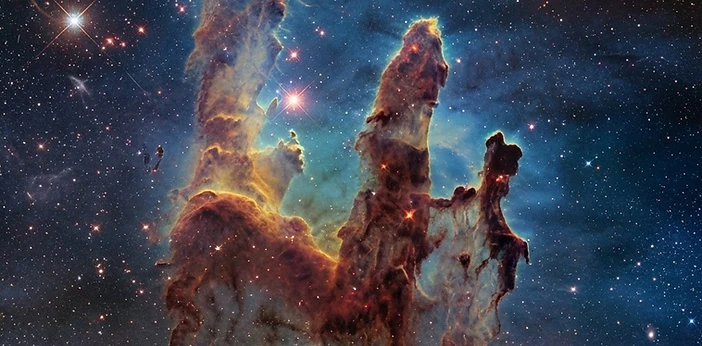
Why We Put a Telescope in Space
The earth’s atmosphere is a gift to our lungs and a veil over our eyes. It bends, scatters, and blurs the light of the stars, so that even the greatest telescopes on the ground see the heavens as if through rippling water. So we did something audacious: we carried a mirror above the air.
The Hubble Space Telescope orbits roughly 340 miles above us, sailing around the earth every ninety minutes. It has no weather, no clouds, no city glow, no twinkling — only darkness, and the steady light of things impossibly far away. It is, quite literally, a window we opened onto the deep.
And the deep looked back. For over thirty years Hubble has been sending images that the human eye has never before been able to see — and every one of them has been a sermon on the greatness of God.
Light That Was Already on Its Way
Some of this light began its journey long before a human ever lifted an eye to the sky. Hubble simply caught it, and gave it to us. Look slowly. These are not decorations — they are declarations.

The Pillars of Creation
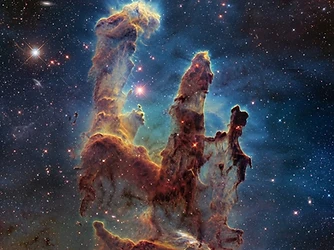
Towering columns of cold gas and dust where new stars are being born — a nursery of light in the Eagle Nebula.
He wraps Himself in light as with a garment; He stretches out the heavens like a tent.

A Spiral Galaxy, Face On
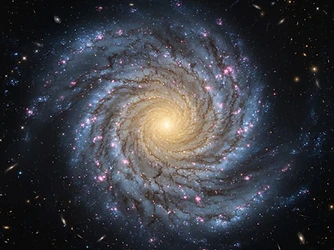
A hundred billion stars turning in ordered arms — and the same God numbers each one by name.
Lift up your eyes on high and see: who created these? He who brings out their host by number, calling them all by name.

The Death of a Star
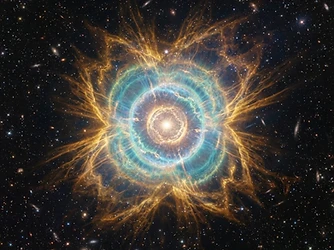
A dying star casts off concentric rings of light — even endings, in God’s cosmos, are made beautiful.
The heavens declare the glory of God, and the sky above proclaims his handiwork.


The Hubble Deep Field
A patch of sky no larger than a grain of sand held at arm’s length — and it held ten thousand galaxies.
When I look at your heavens, the work of your fingers, the moon and the stars which you have set in place, what is man that you are mindful of him?
Ten Thousand Galaxies in a Pinprick of Sky
In 1995, astronomers did something that sounded wasteful: they pointed Hubble at a tiny, almost completely dark patch of sky near the Big Dipper — a spot no bigger than a grain of sand held at arm’s length — and left the shutter open for ten days. They expected little. What came back became one of the most humbling images ever made.
That empty pinprick held nearly ten thousand galaxies. Not stars — galaxies. Each one a vast island of billions of suns. And that was only the light bright enough to catch in ten days. The deeper they looked, the more there was. The universe is not mostly empty. It is mostly full — and we had simply never looked long enough to see it.
When I look at your heavens, the work of your fingers, the moon and the stars which you have set in place, what is man that you are mindful of him, and the son of man that you care for him?
Hubble did not make us small. It only showed us how small we already were — and how astonishing it is that the God who fills ten thousand galaxies in a grain of sand would bend down to know our names.
Beauty Is Not an Accident
An atheist can describe a nebula. He can measure its gases, chart its expansion, name its central star. What he cannot explain — what no equation has ever accounted for — is why it is so beautiful. The cosmos is not merely functional. It is lavish. It is decorated far beyond what survival or physics required.
Scripture tells us why. The heavens do not merely exist; they declare. They speak. They pour out speech day after day, and their voice goes out through all the earth (Psalm 19). Hubble did not invent that voice. It simply gave us ears to hear how loud it has always been.
The heavens declare the glory of God, and the sky above proclaims his handiwork. Day to day pours out speech, and night to night reveals knowledge. There is no speech, nor are there words, whose voice is not heard. Their voice goes out through all the earth.
Every pillar of gas, every spinning spiral, every dying star wreathed in rings of light is a word in a sentence the cosmos has been saying since it was spoken into being: “Great is the Lord, and greatly to be praised.”
Will You Look, and Then Will You Worship?
A telescope cannot make anyone worship. Many of the people who built Hubble, who read its data, who stared longest at its images, never once bent the knee. You can stare into the deep and stay shallow. Wonder, in the end, is a choice of the heart — and a gift of God.
But the pictures are here, now, in your hand. The same God who stretched out these pillars and lit these galaxies is the One who, in the fullness of time, came down. He did not stay distant from the cosmos He decorated. He entered it. He walked its dust. He died beneath its sky and rose while its stars still shone — so that the same heavens that declare His glory might one day be the home of all who love Him.
The next time you see a Hubble image, do not scroll past it. Stop. Let it do to your soul what it was sent to do: make you small, and make God immense — but never small in the sense of forgotten. For the same God who fills ten thousand galaxies calls you by name. You are not just small; you are known, and deeply loved — and this great God, Abba, wants you to know Him. Look up until the smallness becomes wonder and the immensity becomes a Father — and all that is left is worship.
"For this reason I bow my knees before the Father, from whom every family in heaven and on earth is named, that according to the riches of his glory he may grant you to be strengthened with power through his Spirit in your inner being, so that Christ may dwell in your hearts through faith — that you, being rooted and grounded in love, may have strength to comprehend with all the saints what is the breadth and length and height and depth, and to know the love of Christ that surpasses knowledge, that you may be filled with all the fullness of God. Now to him who is able to do far more abundantly than all that we ask or think, according to the power at work within us, to him be glory in the church and in Christ Jesus throughout all generations, forever and ever. Amen."
Paul saw something we often miss when we look at the stars. The vastness above is not meant to dwarf us — it is a picture of the vastness of His love. The same God who stretched out the heavens prayed that we would grasp how wide, how long, how high, and how deep that love reaches. The galaxies are immense because their Maker is immense; and His love is more immense still. Hubble measures the distance to the farthest galaxy, but it cannot measure the love that made it. Only the cross could do that.
A Cross at the Heart of the Cosmos
When pastor Louie Giglio shared his now-famous talk How Great Is Our God, he pointed to a Hubble image that stops the room. It is the Whirlpool Galaxy, M51 — a grand spiral turning in the deep. And at its blazing core, formed by the light and dust of the nucleus itself, there is the unmistakable shape of a cross.
Skeptics will rightly say the cross is a pattern our eyes find in dust and light — the same way we see faces in clouds. Perhaps. But the God who promised that "the heavens declare the glory of God" has never been above using exactly such patterns to point us where He always points: to His Son.
We do not need a galaxy to prove the cross. The cross has already spoken. But oh, the tenderness of it — that at the heart of a hundred billion spinning suns, the shape we are given to see is the shape of our salvation. The cosmos, from its very center, seems to whisper the same word the empty tomb shouted: Christ.


The Galaxy


The Cross at Its Core
For by Him all things were created, in heaven and on earth, visible and invisible, whether thrones or dominions or rulers or authorities — all things were created through Him and for Him. And He is before all things, and in Him all things hold together.
All of it — every nebula, every galaxy, every pillar and spiral and dying star — was made through Him and for Him. Hubble has simply been showing us the cathedral. The cross at its center shows us who it was built for.
The heavens were not built to be understood. They were built to be adored. Hubble simply handed us the eyes to begin.
See More Pictures from Hubble Back to the Journey