Black
Holes
The strangest objects in the sky are places where gravity wins completely — where space folds shut and even light cannot climb out. They are invisible, and they preach. Here is what they are, where to look, and the One whose light no darkness can swallow.

Where Gravity Wins
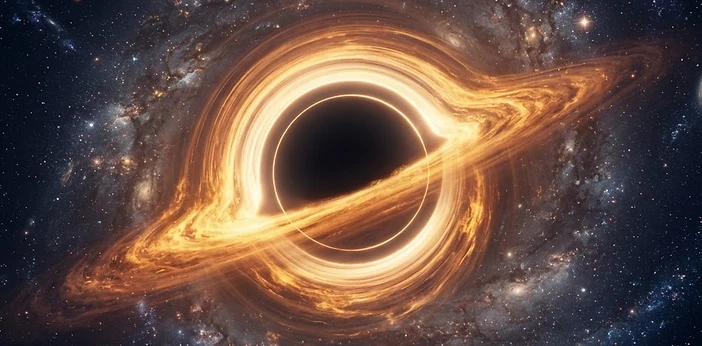
Most of the heavens are bright. Stars burn, planets reflect, nebulae glow, galaxies shine across millions of light-years. A black hole is the great exception: a place where matter has been crushed so dense that its gravity becomes absolute. Near it, space curves so steeply that anything crossing a certain line — the event horizon — falls inward forever. Not even light, the fastest thing there is, is fast enough to climb back out.
And yet a black hole is not empty. It is often the most massive, most influential object in its corner of the sky — pulling stars into orbit, shaping whole galaxies, anchoring the great spiral arms. It is invisible by gravity, not by size. The darkest thing in the cosmos is also, quietly, one of the strongest.
Stellar, Supermassive, and In-Between
Not all black holes are the same. Astronomers sort them by mass, and the differences are enormous.
Born from the death of a single giant star. The most common kind.
Anchors the heart of nearly every large galaxy — including ours.
The rare middle child; still a puzzle to astronomers.
The supermassive ones are the most mysterious. No one is yet certain how they grew so large — whether they formed from giant clouds of gas collapsing directly, or from many smaller black holes merging over time. What is certain is that they sit at the center of galaxies, and the galaxies orbit them.

A Picture of a Shadow
You cannot see a black hole directly, by definition. But you can see what it does to everything around it. As gas and dust spiral inward, they heat up and glow ferociously — the accretion disk — and that ring of fire marks where the dark thing hides. Stars near a galaxy's center can be tracked whipping around an invisible point at impossible speeds, betraying the mass that must be sitting there.
In 2019, a planet-wide team of telescopes called the Event Horizon Telescope did the impossible: it photographed the shadow of a supermassive black hole in another galaxy. In 2022, it captured our own — Sagittarius A*, the one at the center of the Milky Way. The image is not the black hole itself but its silhouette, ringed by the light it is devouring. It is the first photograph of a place from which nothing returns.
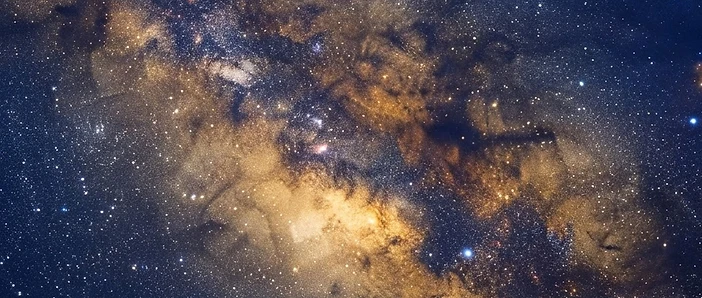
To see it yourself: in the northern summer, the constellation Sagittarius rises low in the southern sky. Follow its famous "teapot" asterism — the spout points toward the dense star clouds of the galactic center, where Sagittarius A* hides behind 26,000 light-years of dust. You won't see the black hole, but you'll be looking straight at the heart of our galaxy.
Where the Laws Run Out
At the center of a black hole, our best physics breaks down. General relativity says matter is crushed to a point of infinite density — a singularity — where the known laws of space and time simply stop working. Quantum mechanics says that cannot be. The two greatest theories of the physical world contradict each other at the bottom of a black hole, and neither can yet tell us what is actually there.
This is not a failure of science so much as a humbling one. The universe contains places the human mind can describe but not fully reach. We can name the darkness; we cannot enter it and return with answers. There is a kind of reverence built into the very geometry of a black hole — a signpost that says, this far and no farther.
“For my thoughts are not your thoughts, neither are your ways my ways, declares the Lord. For as the heavens are higher than the earth, so are my ways higher than your ways.”
A Hole That Cannot Hold Him
And here the wonder turns to worship. A black hole is the one thing in the cosmos strong enough to trap even light — and yet Scripture tells us of a Light that no darkness, however absolute, can overcome. The darkness at the center of a galaxy is real and vast; the Light at the center of creation is vaster still.
“The light shines in the darkness, and the darkness has not overcome it.”
The Greek word for "overcome" here carries the sense of laying hold, of grasping, of pulling down — the very thing a black hole does to light. And John tells us the darkness tried, and could not. The Light that walked out of a borrowed tomb on the first Easter morning is the same Light that was never subject to the gravity of the fall, the gravity of death, or the gravity of any darkness in the cosmos. The strongest force in the universe met the strongest claim in the universe, and the grave could not hold Him.
Every black hole, then, is a quiet sermon in reverse. It shows us the absolute limit of the dark — and by contrast, the One who is beyond every limit. He is not merely brighter than the darkness. He is the Light in which the darkness was even made.
Wonder, Not Fear
A black hole is a strange and fearsome thing, and it is right to feel small before it. But the boundary here is the same as for every object in the heavens. We let it preach of Christ; we do not fear it as a power. We are not subject to the darkness; we belong to the Light.
“For by him all things were created, in heaven and on earth, visible and invisible… and he is before all things, and in him all things hold together.”
Marvel at the science. Track Sagittarius A*. Let the size of it humble you. But keep your awe pointed at the Maker of the darkness, not the darkness itself. The strongest gravity in the sky answers to a stronger Word.
Somewhere at the center of our galaxy, light is falling and cannot return. Somewhere at the center of everything, a Light fell into death — and came back. The darkness did its worst. It could not hold Him.
The Unseen Hand that Holds the Stars Back to the Journey