Virgo
The Seed of the Woman
The heavens tell a story. The ancient order of the Mazzaroth unfolds a single picture of promise, sacrifice, conflict, and victory — beginning with a Seed and ending with a Lion. Yet the stars also move through our evening sky according to the seasons, and the sign that headlines the story in a given month is not always the one blazing overhead that night. On this page you will find both layers held together: the meaning written into the constellation, and the best time to step outside and find it with your own eyes.
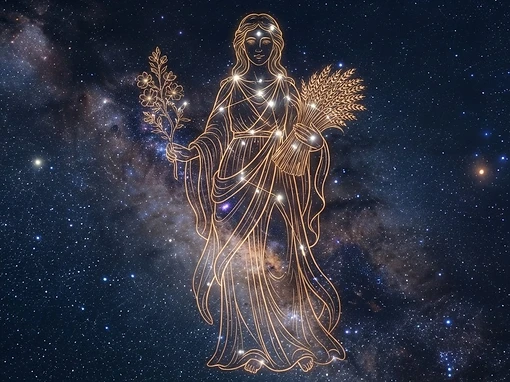
The heavens open with a woman holding a branch and a seed — the first promise, spoken in Eden itself, that a Deliverer would come through her. She carries the Seed who would be struck and yet crush the serpent’s head, the Branch who would rise from a fallen kingdom and bear fruit no man can number. From the very first sign the stars are telling us the story begins not with our reaching up to God, but with God’s coming down to us.
In the live evening sky, Virgo climbs highest and is easiest to spot during March through July. Wait for a clear, moonless night, let your eyes adjust for a few minutes, and scan the path the sun traced earlier that day — that golden highway is where the Mazzaroth travel.
Virgo's chapter opens in Mar–Apr, as the sign first rises into the evening sky — and it stays prominent through March through July. The story for your heart, the sky for your eyes: the narrative can be pondered in any season, but the stars, only in theirs.
She is the first of the Mazzaroth — and that is no accident. Before the scales, before the scorpion, before the lion and the ram, the heavens open with a woman. A maiden stands in the night holding two things: a branch in one hand and a seed in the other. From the dawn of the world the sky has been telling a story, and it insists on beginning here — with a promise that a Deliverer would come through a woman, and that He would be both the Shoot of a new beginning and the Seed from which all life would spring.
The brightest star in her hand the ancients called Zerah — the seed — and later Spica, the ear of grain. In the other hand they saw a branch. Both images run like a river through the whole of Scripture: a Branch that would grow up from a felled kingdom, and a Seed that would fall into the ground and bring forth a harvest no man could number. The heavens were set in their courses long before a prophet put words to the promise, yet they speak the same word.
"I will put enmity between you and the woman, and between your offspring and her offspring; he shall bruise your head, and you shall bruise his heel."
It is the first gospel ever spoken — not from a mountaintop, not through a prophet, but in the wreckage of Eden, addressed to the enemy himself. A woman would have an offspring. That offspring would be struck, would suffer, would be bruised. And that same offspring would deal the blow that ends the serpent's reign. The virgin in the sky is the silent portrait of that promise: she carries the Seed before there is a womb to carry Him, and she holds the Branch before there is a stump for it to rise from.
Seven hundred years before Bethlehem, a prophet dared to name her: "Behold, the virgin shall conceive and bear a son, and shall call his name Immanuel." God with us. The sign in the heavens and the sign in the womb were always meant to be the same sign — the Maker entering His own creation through the very doorway of a woman, just as the stars had said from the beginning.
"There shall come forth a shoot from the stump of Jesse, and a branch from his roots shall bear fruit."
The branch tells us where He comes from — not from a throne in full bloom, but from a kingdom cut down to a stump. The seed tells us what He does — He falls, He dies, He is buried, and in the dying He becomes the source of a multitude. "Truly, truly, I say to you, unless a grain of wheat falls into the earth and dies, it remains alone; but if it dies, it bears much fruit." The maiden in the sky has been holding that grain since the night the stars were made.
So when you find the Virgin low in the east on a late March night — faint, patient, first in the order — let her preach the oldest sermon the heavens know: that the story does not begin with our reaching up to God, but with God's coming down to us. Through a woman. As a seed. As a branch. To bruise a head and heal a world. The whole Mazzaroth that follows is only the unfolding of what she is already holding in her hands.
"Lord, the first word the heavens speak is a woman and a seed. Teach me to begin where the stars begin — not with my strength reaching up, but with Your humility coming down. Let the Branch grow in me, let the Seed fall and bear fruit in me, until the promise held from the first night is held in my own heart. Amen."