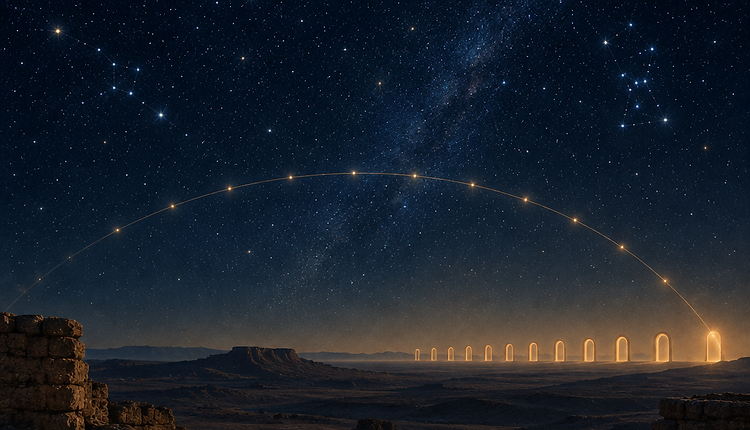
There is a stretch of 1 Enoch that tells no story at all. It just describes the sky.
Chapters 72 through 82 are called the Book of the Luminaries, and they are the oldest surviving part of the collection: fragments of this section were found among the Dead Sea Scrolls. No visions here, no giants, no judgment scenes. An angel named Uriel, whose name means "God is my light," takes Enoch through the workings of the heavens and has him write it all down, all their laws exactly as they are.
What he writes is not poetry. It is accounting. Twelve gates. Eighteen parts to a day. Four days that belong to the year but to no month. Somebody stood under the same sky you can stand under tonight and tried to make it add up.
One honest word before we start. 1 Enoch is not in most Bibles. The Ethiopian church keeps it whole; the rest of us have it as an ancient Jewish writing, quoted once in Jude, and read with interest rather than authority. Which means we can admire it without having to defend every number in it.
What Is the Book of the Luminaries?
It is a guided tour of the sky, delivered by the angel set over it.
Uriel shows Enoch the sun, the moon, the stars, the winds, and the seasons, and explains that each one runs on a fixed law given by God. The book's whole argument is that the heavens are not random. They keep an appointment.
That conviction is the reason it exists. If the lights are lawless, no calendar works, no feast lands on its day, and the whole rhythm of worship comes apart. Enoch is doing what every ancient priest had to do: watching closely, counting honestly, and writing it down so the next generation inherits it.
What Does Enoch Say About the Sun?
Six gateways in the east where the sun rises. Six in the west where it sets. The sun comes up through one, goes down through its partner, and moves to the next gate each month, working north for half the year and back south for the other half.
That is the lengthening and shortening of days, described as architecture.
The book divides a day into eighteen parts and gives the count for every gate. At the fourth gate, near the spring equinox, the day grows to ten parts and the night shrinks to eight, then eleven and seven, until at the sixth gate the day is double the night, twelve parts to six. Coming back down it passes through nine and nine, equal, the way it began. Six parts at the shortest, twelve at the longest, always eighteen in all.
The sun travels in a chariot, and the wind drives it. And in one line that has never stopped being strange: his light is sevenfold brighter than that of the moon; but as regards size they are both equal.
What About the Moon?
The moon uses the same gates, but she is the smaller luminary and she does not make her own light. It is given to her in definite measure. She swells and fades by fourteenths, arrives full at the middle of the month, and runs a shorter year than the sun, roughly 354 days.
The book is careful to say the moon is real and worth counting, and equally careful to keep her second. The sun sets the year. The moon decorates it. Anyone who has ever been told the moon is a goddess should notice what Enoch does with her: she is a lamp with a measured wick, on a schedule, obeying orders.
Where Do the Winds Come From?
Twelve gates for wind, three on each side of the earth. Through four of them come winds of blessing: rain, dew, fruitfulness, prosperity. Through the other eight come the hurtful ones: drought, heat, cold, frost, snow, locusts, desolation.
Weather, in this book, is governed. Not random, and not impersonal. It comes through doors, on time or out of time, and it is tied to the moral order of the world rather than to chance.
Why 364 Days?
Twelve months of thirty days, plus four days added at the end of the third, sixth, ninth, and twelfth months. Three hundred and sixty-four: and the year is completed in three hundred and sixty-four days.
The number is not arbitrary. 364 is exactly fifty-two weeks. Every date falls on the same weekday every year; a feast never wanders and a Sabbath never shifts. Four leaders divide the year into quarters of ninety-one days, twelve leaders divide the months, and heads over thousands divide the days.
Here is the part worth saying plainly, because anyone who reads this book will ask. The true solar year is about 365 and a quarter days. A 364-day calendar is short by roughly a day and a quarter, so a calendar kept by it alone drifts against the seasons. The book presents its number as the exact measure given by Uriel and never describes a correction. The community at Qumran kept this calendar, and the Book of Jubilees assumes it. The Temple in Jerusalem kept a different one, lunar months pulled back into step with the sun. That disagreement was not a footnote in the first century. It was an argument about faithfulness, and it divided people.
What Happens When the Order Breaks?
Chapter 80 changes the mood, and it is the part most people remember.
In the days of the sinners, the years shall be shortened, the seed tardy, the rain kept back. The moon shall alter her order and not appear at her time. The sun shall journey out of course and shine brighter than the order of light allows. Chiefs of the stars shall transgress. And the worst of it: the whole order of the stars shall be hidden from the sinners, so that men shall err and take them to be gods.
Sit with that. The heavens do not stop testifying. The watching stops working. Confusion about the sky is described here as part of the damage sin does, which is why the book cares so much about getting the count right.
Notice also what chapter 80 is not. It is not a physics lecture, and it is not the reason the calendar is short. It is a warning with an end date: evil multiplies, punishment comes, and this disorder does not last.
Does the Missing Day and a Quarter Matter?
The honest answer is that the numbers do not agree. A 364-day year runs roughly a day and a quarter short of the solar year, and the book presents its number as the exact measure Uriel gave, with no correction anywhere in it. That is a real discrepancy, and there is no need to build a case out of it.
What does hold up is the theological reading, and it is the better one. Take 364 as the measure Uriel revealed and 365.2422 as the present we actually keep. Chapter 80 supplies the category for why the two no longer agree: all things on the earth shall alter, and shall not appear in their time (80:2). Things not appearing in their time is exactly what a calendar that has slipped against the seasons looks like. On that reading the gap is not a correction that closes the arithmetic. It is a symptom of the age, the same symptom the chapter names when the moon alters her order and the chiefs of the stars miss the seasons prescribed to them. That is a more modest claim than the earth slowing down and our catching it, because it does not ask the text to solve arithmetic it never set up. And the book can be wrong about the length of the year and still be right about the thing it came to say.
None of which settles what Enoch is, and we are not arguing that it should. It is absent from most Bibles, and nothing here is a bid to put it there. Its value for us is different and more useful: it lets us hear the first century the way the first century heard itself. When the Gospels count the hours of a day, when the feasts are fixed by somebody watching for the new moon, when Jude quotes Enoch by name, there were people listening for whom the luminaries and their gates and their ordered year were ordinary furniture of the mind. Reading this book is one way to learn what they would have understood when they heard him speak.
What Does the Book Get Right?
Three things, at least.
The sky is lawful, and its lawfulness is a mercy. Anyone who has ever planted by a frost date or planned a night out around a full moon has borrowed Enoch's confidence.
Time is holy. Counting days carefully is a form of obedience in Scripture, not bookkeeping. Israel's feasts hung on somebody watching for the new moon and the ripening barley.
And the lights are creatures. Psalm 104:19 says God made the moon to mark the seasons; Psalm 147:4 says he calls the stars by name. Enoch's gates and chariots are one ancient way of saying what the psalms say in a line: these things are on assignment.
Which brings us to the guardrail this whole site stands on. The heavens declare the glory of God. They do not run your life. Jeremiah 10:2 tells us not to be dismayed at the signs of the heavens as the nations are, and Deuteronomy 4:19 says the sun, moon, and stars were given to all peoples but are not to be worshiped. Enoch would agree with both, and he says so in his own way: the luminaries obey a law they did not write. If you want the longer argument about where the twelve stations came from and who named them, it is in who invented the zodiac.
The book's last instruction is to hand the writings to Methuselah, and to keep handing them down. Which is a fair description of what happens on any clear night. Somebody looks up, counts, and tells someone else what he saw.