How do you take a constellation back from people who claim to read your future in it?
You start by asking who drew it. Then you discover the drawing has been redrawn, renamed, merged, and re-narrated by at least six different cultures, none of which were reading your horoscope. And then you look up and realize the light itself was never theirs.
You are not wrong, by the way. When you look at the stars assigned to Virgo, you do not see a virgin carrying seeds, because she is not there. Someone drew her. We can name the someone, roughly date the drawing, and show what that patch of sky was called before the maiden arrived. That is not a defeat for the faith. It is one of the most liberating things you can learn about the night sky.
Was Virgo Ever Really a Virgin?
No. She was a furrow.
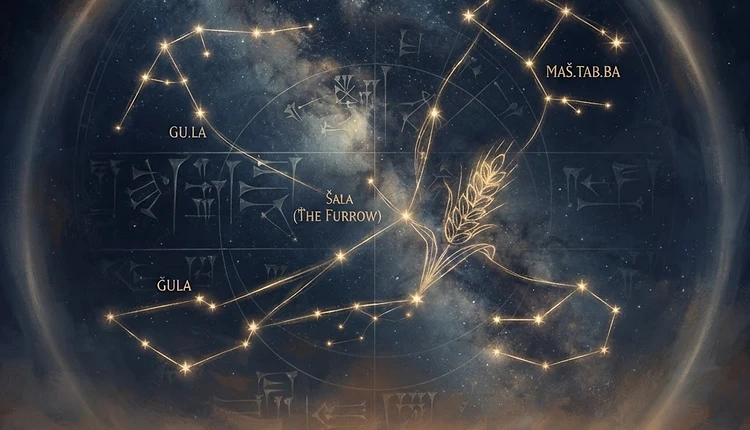
In MUL.APIN, the Babylonian star list compiled around 1000 BC, part of this region of sky is called The Furrow, a field being plowed, tied to the goddess Shala and her ear of grain. The bright star we still call Spica carries the memory in its own name: spica is simply Latin for an ear of grain.
The maiden is a later arrival. When the zodiac was being formalized in Babylon around 400 BC, The Furrow was reworked into The Maiden, and Greek mythographers then supplied her with a choice of identities: Demeter for the harvest, Astraea for justice, Isis, Atergatis, Ishtar. Even the constellation's official boundaries tell the story of stitching. What Hipparchus catalogued as Virgo was two Babylonian figures fused into one, The Furrow in the east and the Frond of Erua in the west.
So your instinct is right, and it is more right than you may have realized. There is no virgin in that patch of sky. There is a furrow, and a wheat ear, and then several centuries of Greek storytelling laid over the top.
Who Actually Invented the Zodiac?
Not the Greeks.
The oldest layer we can read is a set of texts scholars call the Three Stars Each, or the Astrolabes, roughly from 1200 to 1100 BC, though their material reaches back further. They divide the sky into three bands and attach the seasons to the stars that rise in each. The next layer is MUL.APIN, compiled around 1000 BC, a catalogue of about sixty-six constellations, of which eighteen are said to lie in the path of the moon, because the moon travels through them in the course of a month.
Eighteen is not twelve. The moon's road was divided into eighteen stations, not twelve signs.
The twelve-sign zodiac is a Babylonian administrative decision from about 400 BC, when that path was regularized into twelve sectors of thirty degrees each. The oldest surviving personal horoscope is dated to 410 BC. From Babylon the system traveled west, reaching Greece in the fourth century BC, versified by Aratus in the Phaenomena around 270 BC, and finally catalogued by Ptolemy in the Almagest around AD 150, whose forty-eight constellations became the backbone of the eighty-eight we use today.
Put plainly: the Babylonians built the machine, and the Greeks wrote the stories on the outside of it. Astrology runs on the machine. When Christians blame the Greek zodiac, we are aiming at the wrong empire. And when we cede the constellations to the Greeks because their myths feel pagan, we are handing over a system that was never theirs in the first place.
Are the Constellation Lines Actually There?
No. There are no lines in the sky.
A constellation today is a region, not a drawing. The International Astronomical Union fixed eighty-eight of them in 1922, and in 1930 Eugene Delporte drew their official boundaries along lines of right ascension, producing a map of irregular polygons. A star belongs to Virgo because of which polygon it falls inside, not because an ancient poet placed it in the maiden's hand.
The lines people draw inside those regions are art. H. A. Rey, the author of Curious George, published a book in 1952 called The Stars: A New Way to See Them, in which he redrew many of the conventional figures because the traditional lines were so unintuitive that beginners could not find them. His redrawn lines are now in wide use. That is how recent, and how optional, the pictures are.
This is also why you cannot see the virgin. Human beings are compulsive pattern-finders, and it is how we have always remembered the sky. But a mnemonic is not a message. Someone really did superimpose a narrative. Then someone else superimposed a second one, and the software you might use tonight may be drawing a third.
Why Do the Constellation Names Keep Changing?
Because a name is the cheapest thing to change about a sky you did not make.
Libra is the clearest case. It began as the Scorpion's claws, a pair of stars attached to the creature beside them, and the Greek word for those stars was literally the claws. Only later, under Babylonian influence, did that space become the Scales of the balance. A whole sign changed species.
Pisces is another. Two separate Babylonian figures, the Swallow and the Lady of Heaven, were eventually consolidated into the two fishes. And Virgo, as we saw, is two figures fused and then renamed for a maiden.
Count the layers and you get something like this:
- Sumerian and Akkadian sky figures, agricultural and mythic, from the third and second millennia BC
- Babylonian standardization around 1000 BC, and the twelve-sign reform around 400 BC
- Greek mythologizing from the fourth century BC onward
- Latin names and Roman retellings
- Arabic star names from the medieval period, still visible in Aldebaran, Betelgeuse, and Rigel
- Modern boundaries in 1922 and 1930, plus redrawn figures in the twentieth century
Six cultures, one wheat field. That is not a secret code that survived from Eden. That is a human naming project that kept being revised.
What Does the Bible Actually Claim for the Stars?
Less than astrology claims, and more than we usually notice.
Genesis says the lights were made for signs and for seasons, and for days and years (Genesis 1:14). The Hebrew words matter. Signs is otot, markers, the same word used of the rainbow and the Sabbath. Seasons is mo'adim, appointed times, the word used for Israel's festivals. The sky was given as a calendar for worship, not a fortune for individuals.
Psalm 19 says the heavens declare the glory of God, then adds that there is no speech and no words, and that their voice is not heard. The sky speaks without saying anything. Its message is glory, not destiny.
Psalm 147:4 says God determines the number of the stars and gives to all of them their names. Isaiah 40:26 says He brings out their host by number and calls them all by name. Job 9:9 and Amos 5:8 name the Bear, Orion, and the Pleiades as His handiwork.
Then there is the other side, the one the church forgets to quote when it is busy defending the constellations:
Learn not the way of the nations, nor be dismayed at the signs of the heavens because the nations are dismayed at them.
That is Jeremiah 10:2. Deuteronomy 4:19 forbids worshiping the host of heaven. Second Kings 23:5 records Josiah deposing the idolatrous priests who burned incense to the sun, the moon, and the constellations. Isaiah 47:13 mocks the astrologers and stargazers who cannot save anyone.
Notice what Scripture never does. It never once tells us to read fate in the sky, and it never supplies a list of what the signs mean. The Bible talks about the stars constantly and gives a meaning-code for them exactly zero times.
Did God Name the Constellations?
He named the stars. We named the groupings, and the difference is everything.
Job 38:31-32 has God asking Job: Can you bind the chains of the Pleiades or loose the cords of Orion? Can you lead forth the Mazzaroth in their season, or can you guide the Bear with its children? The Hebrew names there, Kimah, Kesil, Ayish, Mazzaroth, are Hebrew words for patterns the audience knew by sight.
Mazzaroth is the interesting one. It appears only once in the Bible, and scholars still debate it: possibly the circle of the zodiac, possibly a specific group of constellations, possibly connected to an Akkadian word for a watch or guard. Even the word may be a loanword from Babylon.
That is worth sitting with. The Bible is perfectly willing to borrow the sky's vocabulary from its neighbors. It is not willing to borrow their religion. Loanwords, yes. Worship, no.
And note what God's question actually is. He does not ask Job whether he can interpret Orion. He asks whether he can bind it, loose it, lead it out. The claim God makes on the sky is creative, not cryptogrammatic. He owns it because He made it, not because He encoded it.
What About the Gospel in the Stars?
This is the question honest people ask next, and it deserves a straight answer.
There is a real tradition, running from Frances Rolleston in the 1860s through E. W. Bullinger and Joseph Seiss, that the constellations were given to the patriarchs as a pre-scriptural prophecy, a star-gospel later corrupted by Babylon. It is a sincere tradition, and it has comforted many believers. It is also a reading we should hold the way we hold anything beloved and unproven — with gratitude, and without asking it to carry more than it can.
It requires three things to be true that the record does not support. It needs the pictures to be ancient and stable, when we have watched them be merged, split, and renamed across a thousand years. It needs a key to the meanings, when Scripture never supplies one. And it needs the stars to function as a cipher, which is the same move astrology makes, only with holier vocabulary. In practice its interpreters disagree with each other constantly, which is what happens when a code has no key.
Our position here is simpler. The constellations are illustrations for God's story, never the source of it. Creation tells us that God is powerful and worthy. It does not tell us His plot.
So Should Christians Ignore the Constellations?
No. Ignoring them is how we lost them in the first place.
The sky has three legitimate jobs in Scripture. It is a witness: it declares glory to people who have never read a Bible, which is Paul's argument in Romans 1:19-20. It is a calendar: the moon marks months, and Israel's feasts were tied to barley and the new moon, which is why Passover falls in the month of Abib, the month of green ears. And it is shared memory: Job, Amos, and Isaiah all assume their hearers can find the Bear and the Pleiades without help.
The church's mistake has not been one error but two. We either ceded the sky to the astrologers, deciding the constellations were pagan property, and stopped looking up. Or we over-corrected and turned the sky into a decoder ring, which made us amateur astrologers with a testimony. Both mistakes treat the sky as a message about me. The middle path treats it as a creature pointing at its Maker.
What Should I Do When I See Virgo Tonight?
Find Spica. Trace the ear of grain, the one piece of the old Babylonian picture that survived every renaming.
Then read John 12:24, where Jesus says that unless a grain of wheat falls into the earth and dies, it remains alone, but if it dies it bears much fruit. Then read Ruth 2, where a widow gleans barley in a field at Bethlehem and does not yet know that the owner of the harvest is about to redeem her.
Notice what that sequence is not. It is not the star encoding the verse. It is the same Lord who made the wheat, telling a parable about wheat, in a town whose name means house of bread. The chain runs from creation to creature to parable to Christ, and it needs no secret code, only eyes.
Who Owns the Night Sky?
You are right that someone drew a narrative on the stars. The lines are human, the names are human, the maiden is a later addition to a furrow, and the twelve signs are an administrative reform from the fifth century before Christ. Defending any of that as divine revelation is a losing argument, and we do not have to make it.
Here is the freedom in it. We do not have to defend Babylon's pictures, or Greece's myths, or a twentieth-century illustrator's lines, in order to defend God's sky. The naming is derivative. The making is original. Psalm 147:4 says He calls the stars by name, and whatever names we give their groupings, His naming is the one that holds.
So take the constellations back the way you take back anything borrowed: hold them loosely, use them gratefully, and give the credit to the One who lit them.
Awe over argument. The wheat was His before it was anyone's sign.