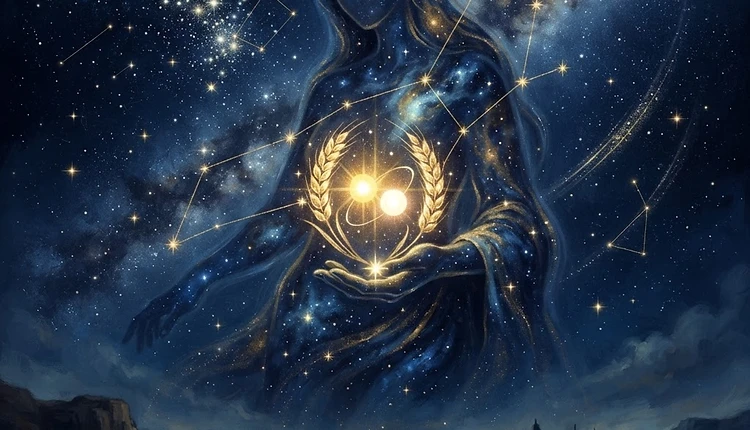
Why Is There a Seed of Wheat in the Virgin's Hand?
Because the heavens have been telling one story from the first night they were made — and the star at the center of it is a picture of that story's first promise. The brightest star in Virgo, the Virgin, is Spica — Latin for "ear of grain," the seed-head of wheat. The ancient world knew it by the name Zerah: the Seed. She holds it out in her left hand like a farmer offering the harvest, and she has held it there since the night God spoke the first gospel into the wreckage of Eden: "I will put enmity between you and the woman, and between your offspring and her offspring; he shall bruise your head, and you shall bruise his heel." (Genesis 3:15)
The Mazzaroth opens with a woman carrying a Seed — the promise that a Deliverer would come through her. The Virgo chapter of this site tells that story at length: the Branch from the stump of Jesse, the virgin who would conceive and bear Immanuel, the Seed that falls into the ground and dies and bears much fruit. This page is about the star itself — the single point of light in her hand — because what astronomy has learned about Spica in the four centuries since the telescope makes the ancient picture shine brighter, not dimmer.
What Kind of Star Is Spica?
Spica lies about 250 light-years from Earth, which means the light reaching your eye tonight left it during the lifetime of the American Revolution. To the naked eye it is one brilliant blue-white point — the fifteenth-brightest star in the night sky — but the telescope reveals it is not one star but two: a pair of blazing suns orbiting each other once every four days, at a distance far closer than Mercury is to our own sun.
They are enormous — roughly eleven and seven times the mass of the Sun, burning thousands of times brighter — and their gravity is so fierce that each one pulls the other out of round. Both stars are egg-shaped, stretched toward each other as they whirl. What looks to us like one serene seed of light is in fact a perpetual, violent, four-day waltz at a quarter of a thousand light-years' distance — and it holds together. Nothing scatters it. The Seed stays in her hand.
What Does the Seed Have to Do With the Gospel?
Everything — because the Seed in her hand is not a picture of the church or of human effort. It is a picture of Christ, and specifically of His dying. "Truly, truly, I say to you, unless a grain of wheat falls into the earth and dies, it remains alone; but if it dies, it bears much fruit." (John 12:24) He spoke those words days before He fell into the ground Himself.
And He was born in the town whose very name means House of Bread — Bethlehem. The Seed who held the stars together was laid in a feeding trough in the House of Bread, and grew up to say "I am the bread of life; whoever comes to me shall never hunger." (John 6:35) When He took the bread at the last supper, He was holding His own emblem: the seed crushed, the grain ground, the bread broken — "this is my body, given for you."
The Virgin has been holding that out to the world for as long as there has been a sky. Look at her hand and you are looking at the gospel's oldest illustration.
How Did Spica Teach Us the Sky Itself Turns?
Around 130 BC, the Greek astronomer Hipparchus did something revolutionary: he compared his own measurement of Spica's position against a measurement taken 150 years earlier by Timocharis of Alexandria. Spica had moved — about two degrees — relative to the point where the sun crosses the celestial equator each spring.
It was not the star that had wandered. It was the sky. Hipparchus had discovered the precession of the equinoxes: the slow 26,000-year wobble of the earth's axis, by which the entire coordinate grid of the heavens drifts like a great wheel, one degree every seventy-two years.
Consider the providence in that. The star God named the Seed is the star that taught humanity the sky itself is on the move — and precession is precisely why no chart, no date, no star-alignment can ever be read as a secret message about events on earth. The coordinates drift and never repeat on any schedule we can pin down. The heavens declare a story, and they jealously guard it from becoming a timetable. The star that heralds the promised Seed is the same star that dismantles every attempt to predict Him.
Why Does the Sun Linger Longest in Virgo?
Here is a quiet fact of geometry. Of all twelve constellations the sun passes through in its yearly circuit, it spends the longest time inside Virgo's borders — about forty-four days, from mid-September through October, more than any other sign of the zodiac.
We do not build doctrine on geometry, and we refuse to read the sky as a code. But we are permitted to smile at what the heavens do: the light of the world tarries longest where the Seed is held. The sun dwells in the Virgin's house longer than in any other, then moves on toward the harvest — the very rhythm of the promise she carries.
Does the Virgin Really Hold a Thousand Galaxies?
Virgo's borders are large — it is the second-largest constellation in the sky — and deep inside them lies the Virgo Cluster: more than a thousand galaxies bound together in a single vast structure, fifty million light-years away, the gravitational heart of the supercluster of galaxies our own Milky Way belongs to. Our galaxy is an outlying member of a structure that bears her name.
So the sign that opens the story with a single Seed in her hand holds, within her borders, the largest thing we belong to. The scale is dizzying — and the scale is the sermon. The God who placed a thousand galaxies in the Virgin's borders is the God who placed one specific Seed in the Virgin's hand, and the Seed is the point of it all.
How Do I Find Spica Tonight?
You need nothing but your eyes and a clear spring evening. Find the Big Dipper, follow the curve of its handle outward — you will arc first to Arcturus, a brilliant orange-gold star. Keep going in the same smooth curve, and you will speed on to Spica: blue-white, sharp, unmistakable. Astronomers have taught it to schoolchildren for generations with one sentence: "Arc to Arcturus, then drive a spike to Spica."
In the sky's seasonal rhythm, Virgo climbs highest in the evening sky through spring and early summer. But the story she carries, like every chapter of the Mazzaroth, can be pondered in any season — even when the stars themselves are on the far side of the sun.
What Should You Do With the Seed She Is Holding?
Tonight, if the season allows, find the Dipper's handle, sweep down the arc, and rest your eyes on Spica. Remember what you are looking at: two suns waltzing in four-day orbit, a star that taught us the whole sky turns, the anchor of the largest structure our galaxy belongs to — one small blue-white seed of light in the hand of a promise spoken in Eden, kept through every empire and every empire's fall, and finally kept in a feeding trough in the House of Bread.
The heavens do not begin with our reaching up to God. They begin with His coming down — through a woman, as a Seed, and the Virgin has never once lowered her hand.
"Lord, the Seed the Virgin holds has been held out to the world since the first night. It fell into the ground, and it bore much fruit, and I am some of that fruit. Teach me to look at that blue-white star the way You look at it — not as a mark in the sky but as a promise kept. And let me hold out to others what You have held out to me. Amen."
Frequently Asked Questions
What does the name Spica mean? Spica is Latin for "ear of grain" — the seed-head of wheat. It names the single star the Virgin holds in her hand. Ancient sources also connected it with the Hebrew word for "seed" (Zerah) and with the Branch imagery of Isaiah 11 — traditions that come to us through ancient star-name records, not from Scripture itself. The Bible does not name Spica directly; it names the promise the picture carries.
Can you see Spica without a telescope? Yes — Spica is among the fifteen brightest stars in the night sky, visible from anywhere on Earth except the polar extremes. Trace the Big Dipper's handle in an arc to the orange star Arcturus, then continue the same curve about the same distance to Spica.
Why is Spica important in the history of astronomy? Around 130 BC, Hipparchus compared Spica's recorded position with a measurement taken 150 years earlier and noticed the star had shifted. From that two-degree drift he deduced the precession of the equinoxes — the 26,000-year wobble of Earth's axis that slowly turns the whole celestial coordinate grid. Spica is, in a real sense, the star that revealed the sky is turning.
Is Spica one star or two? Spica is a close binary: two stars, roughly eleven and seven times the Sun's mass, orbiting each other every four days at a distance closer than Mercury's orbit. Their mutual gravity stretches each star into an egg shape.
Does the Bible support reading meanings into the constellations? Scripture presents the heavens as God's handiwork that declares His glory (Psalm 19:1) and treats the seasonal signs as given for times and seasons (Genesis 1:14). What Scripture forbids is divination — reading the stars to predict or guide life (Deuteronomy 4:19; Isaiah 47:13). Everything on this site is offered as a faithful, non-dogmatic reflection, and we reject all astrology, horoscopes, and date-setting.