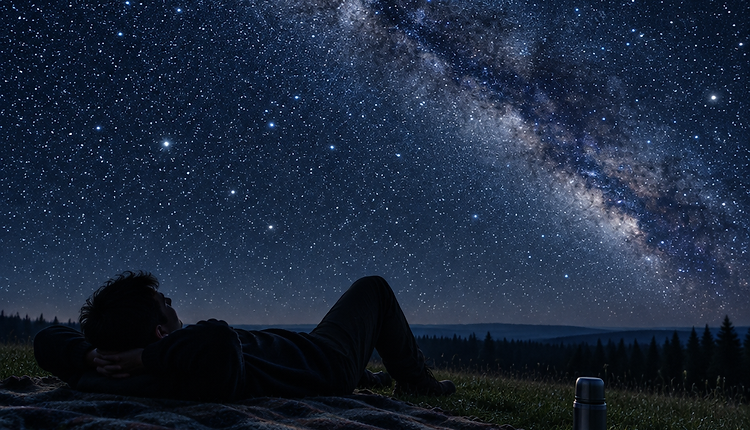
Your First Evening: No Telescope Required
You do not need a telescope. You do not need a course, a planisphere, or a working knowledge of Greek letters. You need one reasonably clear evening, a little patience, and the Book that tells you who hung the stars up there in the first place.
That is the whole entrance requirement for stargazing as a Christian. The rest of this article is simply the quiet first steps, in the order most people find them easiest.
Five Quiet First Steps
1. Learn where north is
Every other direction comes free once you know north. Stand outside, find the direction of north, and suddenly the sky has a shape: the Bear and the north star wheeling in that direction, everything else rising in the east and setting in the west, just as it has every night since Genesis. It takes five minutes and it changes every night afterward.
2. Find Orion
Orion is the friendliest first constellation in the sky: three bright stars in a straight line for the belt, four brighter stars around them for the shoulders and feet. On autumn and winter evenings he climbs in the east while you watch. The first time you find him yourself, without being told where to look, something shifts. You are no longer looking at dots. You are recognizing.
3. Learn the stars the Bible asks about
Here the hobby and the faith meet. Scripture names a handful of sky-objects and asks hard questions about them: Orion and the Pleiades in Job 38:31, the Bear and her children and Mazzaroth in Job 38:32, the seven stars of Amos 5:8. Scrolling the Heavens marks each one on an interactive sky map, with the verses attached, so you can find in the night the same stars God pointed Job to. You are learning the sky on a first-name basis, the names God uses.
4. Read Psalm 19 outside
Read it out loud, under the actual sky, the way it was meant to be heard: "The heavens declare the glory of God; and the firmament sheweth his handywork. Day unto day uttereth speech, and night unto night sheweth knowledge." You will hear it differently outdoors. Everyone does. The psalm was written under this same ceiling.
5. Return weekly
The sky changes its face slowly, and regular watching is how you come to know it. Same time next week, Orion will be higher. The Pleiades will have shifted. In a month, a whole new set of stars will have come over the eastern edge. This is not a task. It is more like getting to know a neighbor you will have for the rest of your life.
What to Skip
Skip the expensive telescope, at least for now. Most beginners who buy one early use it twice. Skip the app-store churn too, the dozen astronomy utilities that bury you in data and never once mention why any of it is lovely. And skip astrology entirely: the stars are not there to tell your fortune. They are there to tell His glory. One map with the Scripture already attached beats a folder of tools every time.
When the Heavens Feel Too Big
Some people look up and feel small. You will, sometimes. That is not a design flaw; that is the beginning of the whole subject. The same Psalmist who felt it wrote the question into the middle of the praise: "When I consider thy heavens, the work of thy fingers, the moon and the stars, which thou hast ordained; What is man, that thou art mindful of him?" (Psalm 8:3-4). The sky makes you small, and then Scripture makes you small and loved at once. That combination is the quietest gift Christianity gives to a stargazer, and it never stops being true, whether it is your first evening or your thousandth.
Frequently Asked Questions
How do I start stargazing as a Christian?
Start simply: learn north, find Orion, read the Job 38 stars with a map like Scrolling the Heavens, and read Psalm 19 out loud under the sky. No telescope needed for any of it.
Do I need a telescope to enjoy the night sky?
No. Nearly everything the Bible mentions about the night sky, Orion, the Pleiades, the Bear, the planets, is visible to the naked eye on a clear evening.
What Bible verses talk about the stars?
Start with Psalm 19:1, Psalm 8:3-4, Psalm 147:4, Job 38:31-32, Amos 5:8, Isaiah 40:26, and Genesis 15:5. Each one is attached to the sky it describes in Scrolling the Heavens.
Read This Series
These three from the same series sit well beside this one: An App That Connects Constellations to Bible Verses, A Biblical Star Map, and Where Do Scripture and Astronomy Meet?.
The first clear evening is yours. The sky has been keeping the same appointment every night for a very long time, and it is looking forward to meeting you: scrollingtheheavens.com.