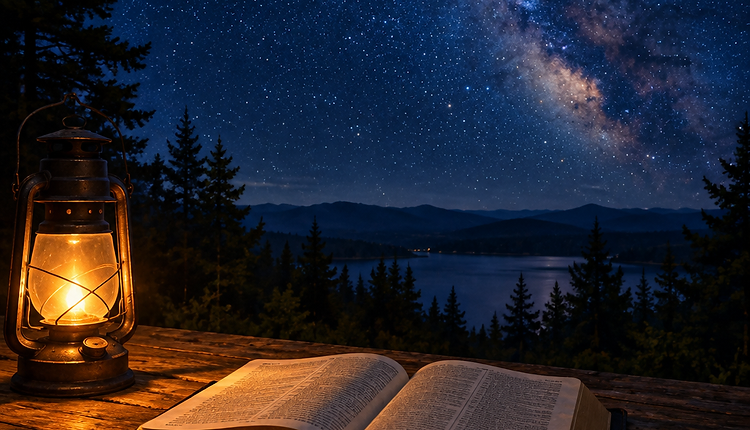
Why the Psalms Belong Under the Stars
The Psalms were not written at a desk. They were sung by shepherds on hillside watches, by travelers under open desert skies, by a king who had spent his boyhood nights keeping sheep with nothing above him but the host of heaven. When David wrote "When I consider thy heavens, the work of thy fingers, the moon and the stars, which thou hast ordained" (Psalm 8:3), he was not quoting an astronomy book. He was remembering nights he had actually spent looking up.
So the Psalms and the night sky were never really separated. They belong together like a song and the evening it was written for. Reading Psalms under the stars is not a new idea. It is the original setting.
A Quiet Practice: One Psalm, One Constellation, Silence
Contemplative stargazing does not need a plan, but it does need a little stillness. Here is the whole practice, if you want one:
Choose a clear evening. Step outside, or to a window that faces the sky. Open Scrolling the Heavens, face the direction it shows you, and choose one thing the sky is offering tonight. Just one: the Pleiades low in the west, the Bear circling the north, Orion climbing in the east.
Then read one psalm. Not five chapters with commentary. One psalm, slowly, the way you would read a letter from someone who loves you. Psalm 19 if the stars feel loud with glory. Psalm 8 if they make you feel small in the best way. Psalm 121 if the night feels heavy and you need the Keeper who does not sleep.
Then be quiet. That is the third step, and the hardest one, and the reason the whole practice exists. "Be still, and know that I am God" (Psalm 46:10) is not a technique. It is an invitation to let the heavens finish the verse they started at sunset.
The Psalms Section of Scrolling the Heavens
Because prayer under the sky needs words that were made for it, Scrolling the Heavens keeps a whole section for the Psalms. Scripture sits there beside original psalms written for the sky itself, including one written for the rain, "A Psalm of the Rain," because the God of the stars is also the God of the weather that finds you tonight. They are there to be read slowly, out under the sky if you can manage it, the way the first psalms were.
Contemplation Is Not Emptiness
Some people hear "contemplative" and think it means emptying the mind. Christian contemplation is the opposite of empty. It is filling the eyes with the heavens and the heart with the Word until both say the same thing: "The heavens declare the glory of God; and the firmament sheweth his handywork" (Psalm 19:1). The sky is not the object of the meditation. It is the sanctuary where it happens.
That is what the Psalms section, and the sky map it belongs to, were built for: to help you pray the way the psalmists prayed, with the stars as witnesses.
Frequently Asked Questions
What is a contemplative stargazing app?
An app built for prayerful, unhurried reading of the night sky. Scrolling the Heavens pairs its interactive sky map with a Psalms section so Scripture and stars can be read together, slowly.
How do I use Psalms while stargazing?
One psalm, one constellation, then silence. Read a single psalm slowly, find one star or constellation in the sky map or overhead, and let the stillness afterward be part of the prayer (Psalm 46:10).
Are there Christian meditation apps for night sky prayer?
Yes. Scrolling the Heavens, at scrollingtheheavens.com, was built specifically for contemplative prayer under the stars, with the Psalms at its center and the sky as its sanctuary.
Read This Series
This post is part of a quiet walk through the sky and the Word. If you are new here, begin with An App That Connects Constellations to Bible Verses: Yes, It Exists, then read A Biblical Star Map: Scripture References on the Night Sky Itself, and come back here for the practice itself.
The psalmists had no app. They had the sky, and they had the words. You have both now, in the same place. Come and be still: scrollingtheheavens.com.