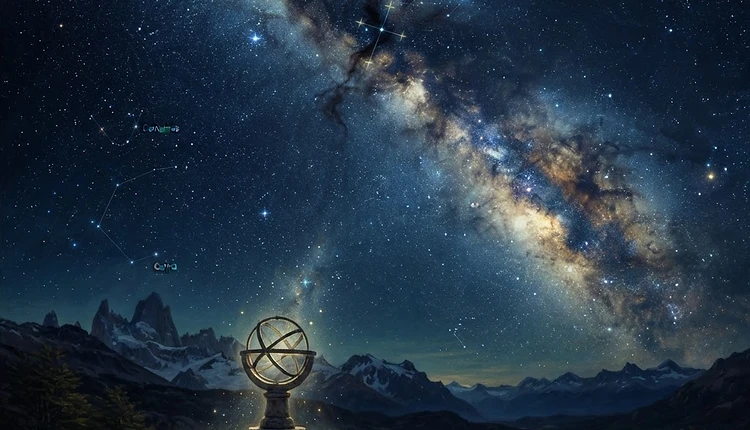
A question found me in the night, the way the best ones do. Suppose I lived below the equator, in Sydney or Santiago or Cape Town. The sky I have watched all my life pivots on Polaris, the North Star, steady above the hub of the turning year. But the southern sky has no such star. What holds it together? And would the Mazzaroth, the twelve-chapter story that runs from the Virgin to the Lion, even make sense from down there?
The short answer is one of the most wonder-full things I know about the heavens: the story does not change, and the view changes completely. And the difference preaches.
The Pole Without a King
From Florida, the whole vault turns around Polaris like a wheel around its hub. Sailors have trusted that star to hold still, shepherds have steered by it, and everything that rises and sets in my sky circles around it in patient rings. Cross the equator and Polaris sinks below the horizon for good. The southern heavens still turn, still pivoted on one fixed point, but that point is empty. There is a star there, Sigma Octantis, so faint that from a city street you will never once see it. No king star. No fixed light standing at the center. The constellations wheel around a vacancy.
But the south is not without a pointer. The most famous constellation below the equator is the Southern Cross, small enough to fit in the palm of an outstretched hand, and sailors learned to extend its long axis about four and a half times its own length and trust where it landed. The cross does not sit on the pole. It points to a place where nothing stands, and the empty spot it names is true.
The Same Story, the Other Way Up
The twelve signs of the Mazzaroth ride the ecliptic, the sun's road through the stars, and that road belongs to everyone on earth. From Sydney, the Virgin still opens the story and the Lion still closes it. The chapters arrive in the same order, in the same months, on the same road.
But the figures stand the other way up. Orion walks on his head. The Bull charges feet-first out of the sea. The Lion leaps tail-foremost, mane hanging beneath him like a banner flown upside down. Nothing has changed about the story. Everything has changed about your seat in the reading room.
What the South Sees Better
And here the wonder tilts toward envy. The southern half of the world gets chapters we only squint at. From Florida, Scorpius barely lifts its arch above the southern murk; we see the great enemy flattened against the horizon, its tail never fully clear. From Australia, the whole scorpion climbs high and rides near the top of the sky, red heart burning, with the Archer's arrow aimed straight at it, and the glory of that conflict is staged overhead in plain view.
The south also gets the heart of the Milky Way pouring nearly overhead instead of sitting on the horizon, the two Magellanic Clouds, little companion galaxies that hang in their sky and never once rise in mine, and Alpha Centauri, the nearest of all the stars, so close that its light left home only four and a half years before it reaches your eyes. The story is one. The windows are many.
The Seasons Turn Over
The calendar chapters hold, but the seasons beneath them flip. When the Lion rises in February over my roof, it is winter here. The same February over Sydney is high summer, and the Lion rides a warm night upside down, on the far side of the year's warmth from me. The spring that opens the Virgin's chapter arrives at the opposite turn of the year for them.
Psalm 19 says of the heavens, "Their voice goes out into all the earth." Not their translation goes out. Their voice. One witness, sworn in every latitude, from whatever window each watcher happens to stand at.
The Sermon of the Empty Pole
Here is where the wonder crosses over into worship.
"Faith is confidence in what we hope for and assurance about what we do not see" (Hebrews 11:1). The southern sky is the fullest picture of that verse I know in nature. Every star in that hemisphere, every night of every year, revolves around a point that is holding everything and showing nothing. The still point governs whether or not it announces itself. It does not need a signpost to sit at the center of the turning.
Maybe that is exactly why the southern pole was left unmarked. The north gets a star to steer by. The south gets a cross that points at a vacancy, and a sky that obeys a stillness no eye can find. Both halves of the world are being taught the same lesson from opposite sides of the room: the heavens do not turn because something bright is pushing them. They turn because Someone is holding them. And He was under the southern sky too, all along.
Would the Mazzaroth Change?
Not one chapter. The Virgin still comes first and the Lion still comes last, from every hemisphere on earth, the same sky telling the same story to every nation. What changes is your place in the reading room, and that may be the deepest wonder of all: not one sky for one people, but one Word that reads true from every window under it.
"Lift up your eyes on high and see: who created these? He who brings out their host by number, calling them all by name" (Isaiah 40:26).
He calls them all by name. Even the watchers He never gave a pole star.