The year has seven weeks left, and its best sky is still ahead of it.
Tonight the Northern Taurids are at their peak: a handful of meteors an hour, most of them faint, with the occasional fireball that makes the whole wait worthwhile. It is a modest beginning, and modesty is how the sky usually works. The great nights never announce themselves. The people who see them are simply the ones who were already outside.
So here is what remains of 2026, from the middle of November to the last night of December. Not a list of omens. A calendar of appointments, kept by the lights that mark them. Times are given in eastern time; the order of events holds anywhere in the northern hemisphere.
Where Should I Start This Week?
Look east before you go to bed, and you will see winter arriving.
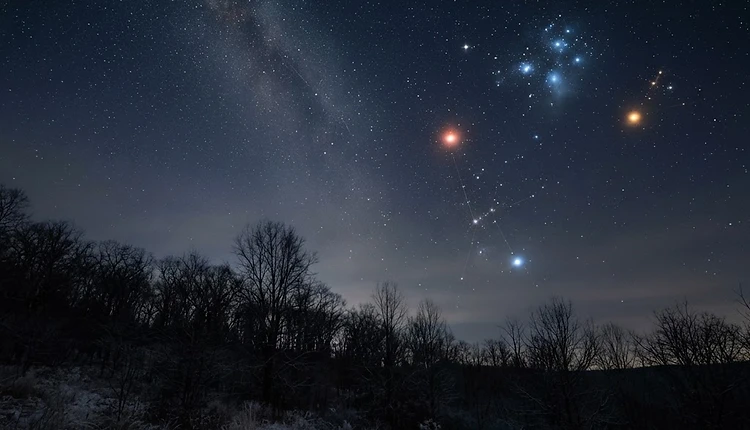
By mid-November Saturn is already high in the south when the sky goes fully dark, and it does not set until about three in the morning. Mars and Jupiter rise together a little after eleven. And in the hour before dawn, Venus stands brilliant in the east, back as the Morning Star, brighter than anything else up there.
That is four of the five naked-eye planets in one ordinary night, with no equipment and no planning. Just a door, and a cold minute of standing outside.
The furniture of the sky has changed too. Orion is up in the east by late evening, three belt stars in a line so straight it looks deliberate. Follow that line down and left and you arrive at Sirius, the brightest star of the night. Follow it up and right and you reach Aldebaran, the red eye of Taurus, with the Pleiades just beyond it: a smudge of frost until you look slightly away from it, and then six stars, and then more than six.
It is worth remembering whose stars these are. Job 9:9 names the Bear, Orion, and the Pleiades as the handiwork of God. Job 38:31 has God asking a man whether he can bind the chains of the Pleiades or loose the cords of Orion. We are watching the same sky a man was questioned about out of a whirlwind.
Which Planets Are Up in November?
Three dates, and the month is done.
November 15 and 16, before dawn. Mars and Jupiter pass within about 1.2 degrees of each other, a little more than the width of two full Moons side by side. Jupiter is the brighter of the pair; Mars is the reddish point just beneath it. They rise together near eleven the night before, so the pairing looks just as good at two in the morning as it does at five.
Around November 20. Mercury makes its best morning appearance of the year, low in the east before sunrise. It is a small, bright, slippery thing that hides in the glow, so give yourself a flat horizon and twenty minutes with no screen.
November 25. Uranus reaches opposition: up all night, and as bright as it ever gets. At magnitude 5.6 it sits just at the edge of naked-eye visibility under a truly dark sky, and it is easy in binoculars once you know which patch of Taurus to hunt in. This is the friendliest week of the year to find it.
And What Changes in December?
December is the better half of the season, and it belongs to three planets at three different hours of the night.
Saturn is the evening planet. As darkness falls it stands high in the south, then drops west and sets around one in the morning by mid-month, earlier each week after that. Point a small telescope at it once this year: the rings are nearly edge-on, tipped at only about six degrees, their thinnest appearance in years. Saturn looks like a pale gold bead with a line through it, and it remains the strangest and most beautiful thing most people will ever see through a lens.
Jupiter comes up in Leo a few degrees from Regulus, and by mid-December it is the brightest thing in the east by about half past nine. It stands still against the stars around December 12 and then begins to drift back, on its way to a February opposition.
Mars rises behind it, around ten o'clock by mid-month, in the same constellation, brightening from magnitude +0.5 to about −0.1 across December. It is heading for opposition on February 19, but for now its disc is small. Save the surface detail for February and enjoy the color, which is the color of a dying coal.
Venus is the morning planet, and the star of the whole season. Late in November it reaches greatest brilliancy, near magnitude −4.9, brighter than it will be again for well over a year. Through December it climbs higher before dawn, standing nearly thirty degrees up in the southeast by mid-month and rising almost four hours before the Sun. There is no missing it. It is the reason people pull over on the highway and ask each other what that is.
Mercury's morning showing ends in the first days of December, and it disappears into the Sun's glare until the new year.
What Are the Best Moon Meetings?
The Moon is the cheapest telescope in the world, and December gives it four good appointments.
December 4 and 5, before dawn. A thin crescent Moon sits between Venus and Spica, the bright star in Virgo whose name means ear of grain. Three lights in a line one morning, a triangle the next. If you have read anything on this site about Virgo and her wheat, this is the sky saying it back to you in the plainest way possible.
December 18, evening. The Moon passes about six degrees from Saturn, low in the south after dark.
December 21, evening. A nearly full Moon crosses within a degree of the Pleiades: close enough to wash the cluster out, close enough to be worth the trip outside anyway.
December 27 and 28, late evening. The Moon rises with Jupiter on the 27th and with Mars on the 28th, in Leo, with Regulus nearby. A small bright gathering in the east around ten o'clock.
Which Night Is the One to Guard?
The night of December 13 into the morning of December 14: the Geminids.
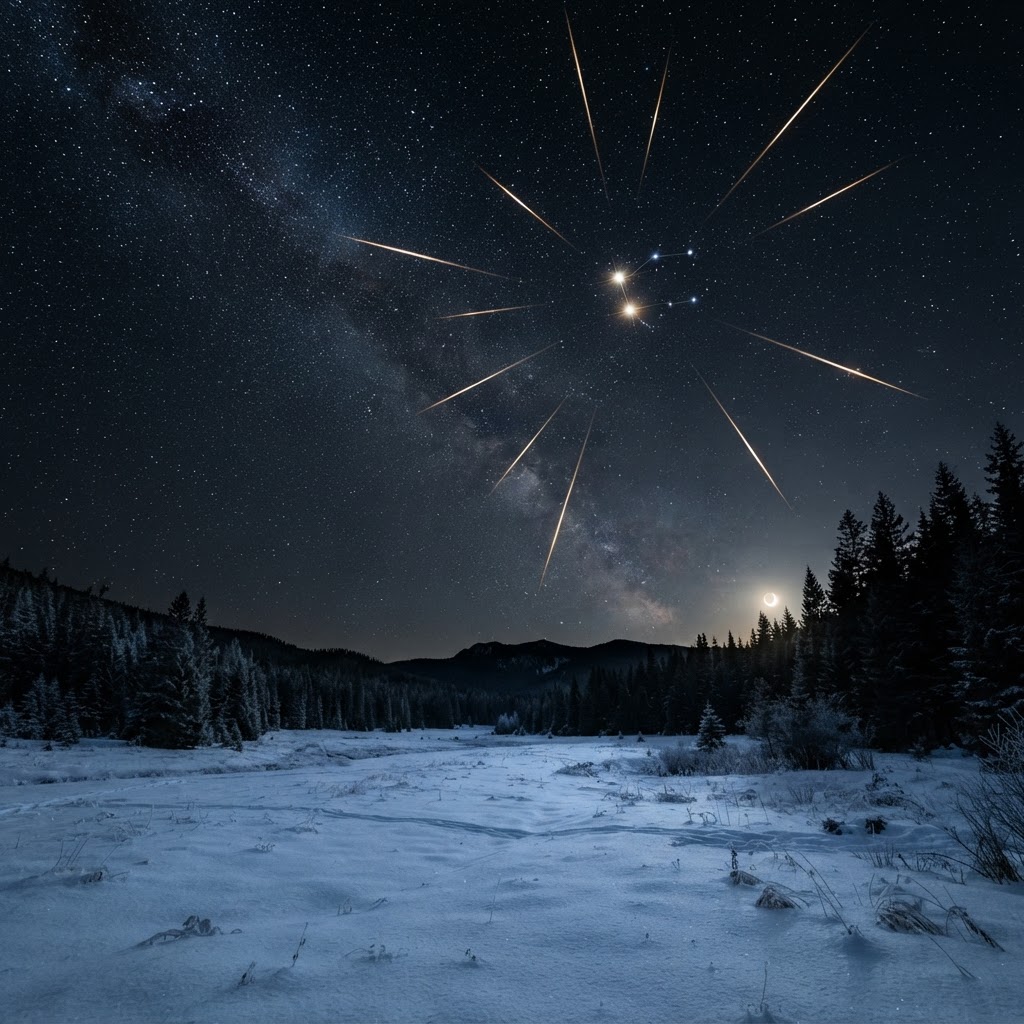
They are the strongest shower of the year, up to 120 meteors an hour under a dark sky, and they are strange in two ways. Their parent is not a comet but an asteroid, 3200 Phaethon, a rocky body that sheds a trail of grit, and the meteors are that grit burning up in the upper air. And they are the rare major shower that gets going before midnight, with the radiant in Gemini well placed by ten or eleven.
This year the timing is nearly perfect. The Moon is a 21 percent crescent that sets around a quarter to nine in the evening, leaving the rest of the night dark. The predicted peak is 12:44 a.m. eastern on the 14th, and the radiant climbs highest around two.
You need nothing for this. Lie back, let your eyes have twenty minutes without a screen, and look up and a little away from Gemini rather than straight at it; the meteors will appear to streak out of the radiant in every direction. Dress warmer than you think you need to, and plan to stay out longer than you intended. That is how these nights go.
The Leonids peak around November 16 and 17, before dawn, after the first-quarter Moon has set, at perhaps fifteen an hour. The Ursids peak on December 21 and 22 under a nearly full Moon that spoils almost everything, so skip them this year and wait for the Quadrantids on January 3 and 4, 2027, which arrive with no Moon in the way. There is more on all of them on the meteor showers page.
What Happens on the Longest Night?
The December solstice falls on Monday, December 21, at 3:50 p.m. eastern. That is the moment the northern hemisphere leans farthest from the Sun: the lowest noon sun of the year, the longest shadows, the longest night. From then on the light comes back, a few seconds at a time.
Two nights later the Moon is full, and it is the closest full Moon of 2026. Full at 8:28 p.m. eastern on December 23, at a distance of 221,612 miles, roughly 14 percent wider and 30 percent brighter than the year's most distant full Moon. It rises around sunset, and because it stands opposite the low winter Sun it climbs higher than any other full Moon of the year and stays up longer. The almanacs call it the Cold Moon, or the Long Night Moon, which is the better name.
That is the shape of the season, and it is worth naming plainly. The longest night of the year is not a night of dread. It is a night that has been measured, and it ends.
Seven centuries before anyone wrote the solstice into a church calendar, Isaiah described the world in the same shape: The people who walked in darkness have seen a great light; those who dwelt in a land of deep darkness, on them has light shone (Isaiah 9:2). He was not talking about the tilt of the earth. He was talking about a deeper night, and a Light that would enter it. But the shape is the same, and it is a mercy that the year repeats it every December: the darkness reaches its limit, and then it begins to lose.
That Light did not arrive in the sky. It arrived in a stable. The star the Magi followed is worth thinking about carefully, and what they knew and what they did not is the honest place to take that question. What the long nights point toward is not a sign to be decoded but a Child in a manger, and the darkness has not overcome Him.
Even the darkness is not dark to you; the night is bright as the day, for darkness is as light with you. Psalm 139:12
What Does Advent Have to Do With the Sky?
Advent is the church's season of watching: four weeks of being told to wait for a light that has already come and is still coming. That is precisely the discipline the night sky teaches. Nobody learns the heavens in one evening. You go out, you look, you go out again, and after a few weeks the scattered points have become landmarks you can find without thinking. Advent is built on the same patience.
Both are acts of sustained attention in a culture that has trained us out of it. We lift our eyes hundreds of times a day and almost never lift them past the roofline. Standing in the cold for twenty minutes with nothing to check is a small rebellion, and the church has been prescribing it for centuries under another name.
On Christmas Eve, if the night is clear, there is a verse worth reading outside: And in the same region there were shepherds out in the field, keeping watch over their flock by night (Luke 2:8). The first people told about the birth were people already awake in the dark, already looking up. The glory of the Lord shone around them, and the first thing they were told was not to be afraid.
If you want to keep the practice past New Year, the Psalms page holds readings written for exactly this kind of looking, and Guardrails explains why we watch without reading fate in what we see.
How Should We Read a Night Like This?
Carefully, and with thanks. Genesis 1:14 gives the lights their jobs in a single sentence: they are for signs and for seasons, for days and for years. A calendar for worship, not a fortune for individuals. Jeremiah 10:2 tells us not to be dismayed at the signs of the heavens as the nations are dismayed at them, and Deuteronomy 4:19 forbids bowing down to the host of heaven, which is the oldest mistake there is and still the easiest.
The stars are creatures. They keep their appointments, and the keeping of them is the whole point. That is what Psalm 19 means when it says the heavens declare the glory of God and then adds that there is no speech and no words: the sky says nothing, and says everything. It is what Job 38:33 presses when God asks, "Do you know the ordinances of the heavens? Can you establish their rule on the earth?" The ordinances are His. Our work is to notice them.
And the thing this season is really about is not in the sky at all. The Light came into the darkness, and the darkness has not overcome it (John 1:5). The last page of Scripture describes a city with no night in it, because the Lord God is its light (Revelation 22:5). Every long evening between now and then is a small rehearsal for that.
What Should I Actually Do Tonight?
Six things, and not one of them costs anything.
- Find a spot away from streetlights, facing east or south, with as little glare as you can manage.
- Give your eyes twenty minutes. No phone, no headlights. It takes that long for the pupils to open and the faint stars to arrive.
- Dress for twenty degrees colder than the thermometer says. Cold is the only thing that reliably ends a night early.
- Start with Orion's belt, then trace outward to Sirius, Aldebaran, and the Pleiades. Landmarks first, then wandering.
- If you want help naming what you are seeing, the Sky Map will draw the sky over your own location, and Tonight's Sky will tell you what is above your horizon right now.
- Before you go back inside, read Psalm 8. It was written by someone doing exactly what you are doing.
The sky has seven weeks of appointments left in 2026, and not one of them is empty. Venus will be at its best in the first days of January, the Quadrantids follow, and the wheel keeps turning the way it has since the fourth day.