
Why Is the Lion's Brightest Star Named "Little King"?
Because the heavens end their story the way a kingdom ends its long night — with a King enthroned. The brightest star in Leo is Regulus, Latin for "the little king." The name we use comes from the Renaissance, but the royalty is far older: Babylonian sky-watchers called this star LUGAL — "the king" — standing in the breast of the Lion, and the Arabs called it Qalb al-Asad, "the heart of the lion." For as long as men have drawn pictures in the sky, this single blue-white point has been understood the same way: the Lion's heart is the King.
The Leo chapter of this site tells the meaning at length — the scepter of Judah, the Lion who conquered by becoming the Lamb who was slain, the roar that ends the war that began in Eden. This page is about the star itself — because what astronomy has learned about the King's heart makes the chapter's last line truer than its ancient namers could have known: every other throne in the universe is temporary.
What Kind of Star Is Regulus?
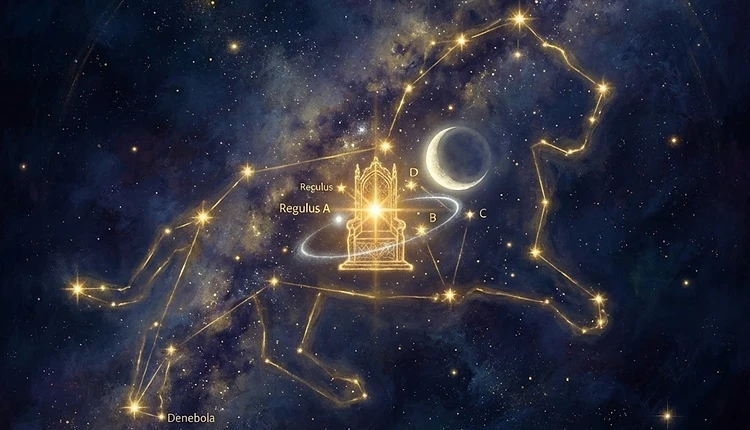
Regulus lies seventy-nine light-years away — so the light reaching your eye tonight left it in about 1947, and has been crossing the dark ever since. To the eye it is one brilliant blue-white point, the brightest star in Leo. The telescope tells a stranger story: Regulus is not one star but four — a whole royal court.
The King himself, Regulus A, is a blue-white giant about four times the Sun's mass and hundreds of times its brightness, spinning on his axis once every sixteen hours — a mad, whirling rotation that visibly flattens him. He is nearly a third wider at his equator than at his poles, and the speed of the spin makes his poles burn hotter and brighter than his waist. Astronomers call it gravity darkening; the King of the Lion's heart is shaped like a pale blue spinning top.
He does not spin alone. Close by, orbiting every forty days, is a white dwarf — a dead star, an ember collapsed to the size of a planet. And far out in the dark, so distant that the light of the King's face takes nearly a month to reach them, two small orange suns circle each other as they make their slow, ancient circuit of the throne.
Why Does the King's Heart Share Its Court with a Dead Star?
Because the dead star was not always dead — and this is the part no one could have guessed from a tent in the ancient world. Astronomers believe the white dwarf was once the larger of the two suns, the true heir of that system. It burned through its life faster, swelled into a red giant, shed its outer layers onto its smaller companion — and that stolen inheritance is likely what set Regulus whirling at sixteen hours a turn. The King's mad spin is the dead star's bequest. Then, its wealth exhausted, the greater light collapsed into an ember, and now circles the King it once outshone.
The heavens agree with the chapter: every other throne is temporary. The brightest throne in that system burned out, shrank, and now orbits in the dark. Meanwhile heaven says of the true King: "The kingdom of the world has become the kingdom of our Lord and of his Christ, and he shall reign forever and ever." (Revelation 11:15) Every empire is a dwarf star circling somebody else's glory. Only one throne does not shrink.
What Happens When the Moon Hides the King?
Regulus sits almost exactly on the path the Sun travels through the heavens — closer to it than any other bright star in the sky. That single fact of geometry makes the King star the one the Moon most loves to hide: because the Moon rides that same path, it passes directly in front of Regulus again and again, blotting the Lion's heart out of the sky and giving it back minutes later. The Moon has been playing this game of hide-and-return with the King for as long as there have been eyes to watch. In 1959 the planet Venus itself slid across the King's face and extinguished him for a few minutes — the last planetary eclipse of Regulus any human being now alive will ever see, and one that will not happen again for centuries.
The sky has been rehearsing one motion over and over for five thousand years: the King hidden — the King returned. We do not build doctrine on alignments, and we refuse to read the sky as a code. But we are permitted to hear the rehearsal for what happened on a Friday outside Jerusalem, when the true King was hidden in a tomb and every eye that loved Him watched the dark. He returned once — and the difference between the star and the King is that the Lion's heart can be hidden again, but the reigning Christ cannot. "I died, and behold I am alive forevermore." (Revelation 1:18)
What Were the Four Royal Stars?
Three thousand years before Christ, the sky-watchers of Persia crowned four stars as the Royal Stars — the honor guard of the heavens, one posted at each of the sky's four quadrants: Aldebaran in the east, Regulus in the north, Antares in the west, Fomalhaut in the south. Each stood watch over a turning point of the year.
Time has not been kind to the honor guard. The slow 26,000-year wobble of the sky — the same drift that Spica revealed to Hipparchus — has carried the posts away from their markers. The watchers stand where they stood, but the year has shifted around them. Three of the four royal stars no longer hold the stations they were crowned for.
The fourth is still on duty. Because Regulus lies closest of all bright stars to the Sun's own highway, the slow turning of the sky has moved everything except his claim. The Persian name for the northern watcher was, fittingly, the one history kept: Venet, the guardian of the north — but every language that star has ever worn says the same word. King. The quadrants of an old empire dissolved, and the King star kept his post. Empires are temporary. The heart of the Lion is not.
Why Is the Lion's Head Drawn as a Sickle?
Step outside on a spring evening and Leo stands high in the south, and the Lion's head is unmistakable: a backwards question mark of stars that stargazers have long called the Sickle — the curved blade of a harvest tool, with Regulus, the King, set at its very base.
We do not build doctrine on asterisms. But Scripture itself gives a sickle into a King's hand at the end of all things: "Then I looked, and behold, a white cloud, and seated on the cloud one like a son of man, with a golden crown on his head, and a sharp sickle in his hand... 'Put in your sickle, and reap, for the hour to reap has come, for the harvest of the earth is fully ripe.'" (Revelation 14:14–15)
Notice where the Mazzaroth began: with a Seed of wheat in a maiden's hand. And notice how the heavens have drawn the sky's last chapter: a King at the base of a harvest blade. The story that opens with a Seed falls closes with a harvest reaped, and the reaper wears the crown. The ancients did not invent the correspondence; they were only the first to draw it. But draw it they did — and we are permitted to smile at what they saw.
How Do I Find Regulus Tonight?
You need nothing but your eyes. On a clear evening between February and May, look to the east and find the backwards question mark rising — that is the Sickle, the Lion's head and mane. Regulus is the bright blue-white star at the bottom of the curve, the dot on the question mark, the Lion's heart. Behind it, three stars trace the Lion's body to a triangle at the tail — the hindmost is Denebola, the star the ancients called the judge who comes.
Virgo holds her Seed in the neighboring stretch of sky, and the two are near enough to see in one slow sweep: the promise and its fulfillment, the maiden and the Lion, in a single field of stars. The story for your heart, the sky for your eyes — the narrative can be pondered in any season, but the stars, only in theirs.
What Should You Do With the King in the Lion's Heart?
Tonight, if the season allows, find the question mark and rest your eyes on its base. Remember what you are looking at: a king spinning at nine-tenths of the speed that would tear him apart, a dead heir circling his throne in the dark, two distant courtiers a month's light from his face — one blue-white point that every civilization from Babylon onward has crowned with the same title, kept at the center of the Lion the story ends with.
And remember the year his light left: 1947. Seventy-nine years that light has been crossing the dark toward your eye — through every empire's rise, every empire's collapse, every decade men said the King was far away or not coming back. The light was in transit the whole time. It is always in transit the whole time.
The Mazzaroth begins with a Seed in a maiden's hand and ends with a King in a Lion's heart — and neither hand has ever let go.
"Lord, every other throne in my life has shrunk or will — every hope I've crowned, every certainty I've propped up. Only Your reign does not wobble at nine-tenths of its limits; only Your kingdom does not decay to an ember. Teach me to keep my eyes on the King at the base of the Sickle, and to live tonight like the harvest is ripe and the light is almost home. Come, Lord Jesus. Amen."
Frequently Asked Questions
What does the name Regulus mean? Regulus is Latin for "little king" — a name that entered astronomy in the Renaissance, though some attribute the coinage to Copernicus. The royalty is far older: Babylonian records called this star LUGAL, "the king," standing in the breast of the Lion, and Arabic astronomy called it Qalb al-Asad, "the heart of the lion." Scripture does not name Regulus; it names what the picture proclaims — the scepter of Judah and the Lion who conquers.
Is Regulus one star or four? Regulus is a quadruple star system. The bright component, Regulus A, is a blue-white star about four times the Sun's mass, spinning once every sixteen hours — fast enough to visibly flatten it. A white dwarf — a dead, collapsed star — orbits it every forty days, and a distant pair of small orange stars circles the system far outside, over 100 billion kilometers away.
Why does the Moon sometimes block Regulus? Regulus lies closer to the ecliptic — the Sun's yearly path — than any other first-magnitude star, and the Moon travels nearly the same path. As a result the Moon passes directly in front of Regulus in a regular series of occultations, hiding the Lion's heart for minutes at a time. In July 1959 the planet Venus occulted Regulus — an event that will not recur for centuries.
What is the Sickle in Leo? The Sickle is the asterism — a recognizable star pattern — that traces the Lion's head and mane: a backwards question mark of stars with Regulus at its base. On spring evenings it rises in the east ahead of the Lion's body. Asterisms are human shorthand for finding stars; we treat them as helpful maps, never as messages.
Does the Bible support reading meanings into the constellations? Scripture presents the heavens as God's handiwork that declares His glory (Psalm 19:1) and treats the seasonal signs as given for times and seasons (Genesis 1:14). What Scripture forbids is divination — reading the stars to predict or guide life (Deuteronomy 4:19; Isaiah 47:13). Everything on this site is offered as a faithful, non-dogmatic reflection, and we reject all astrology, horoscopes, and date-setting.