
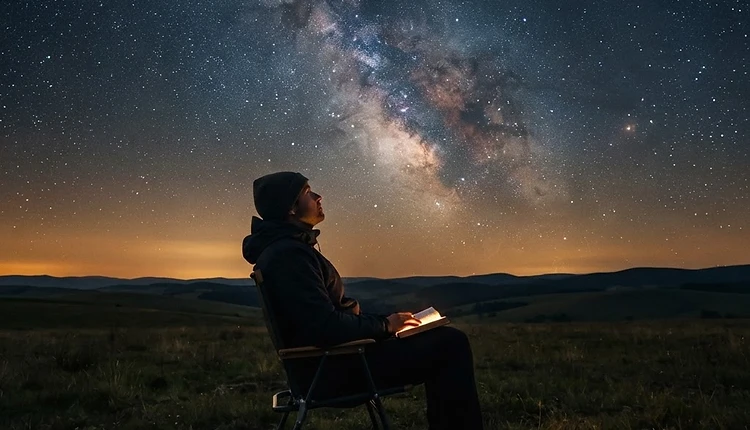
The Psalms are the Bible's own stargazing journal. Again and again the psalmists step outside, look up, and turn what they see into worship — the heavens declaring glory, the stars praising their Maker, a God who counts and names each one. If you want Scripture for contemplative stargazing, the Psalms are where to begin: read one aloud under an open sky and let the same silence the psalmist sat in do its work on you.
Here are the psalms that look up, and how to pray them under the stars.
Psalm 19: The Sky Is Already Preaching
"The heavens declare the glory of God; the skies proclaim the work of his hands" (Psalm 19:1). The psalmist says this preaching happens "night after night" — and that it happens without a single word. That's why stargazing can feel like worship without effort: the sermon has already started before you step outside. Your only job is to attend.
Psalm 8: The Question the Sky Asks
"When I consider your heavens, the work of your fingers, the moon and the stars, which you have set in place, what is mankind that you are mindful of them?" (Psalm 8:3-4). Notice the sequence: consider, then wonder. The sky does something no sermon can — it makes you small without making you worthless, because the God who set the stars is the same one who crowned you "with glory and honor" two verses later.
Psalm 136: The Lights That Govern
"[He] made the lights… the sun to govern the day… the moon and stars to govern the night" (Psalm 136:7-9). This psalm was written to be sung in community, with the refrain "His love endures forever" repeating twenty-six times. The stars aren't decoration — they're governance, the faithfulness of God written into the rhythm of every evening. The sun sets on schedule tonight because His love endures.
Psalm 147: He Counts the Stars and Heals the Brokenhearted
This may be the most tender verse about stars in the Bible: "He determines the number of the stars and calls them each by name" (Psalm 147:4). Read the verse before it: "He heals the brokenhearted and binds up their wounds." The psalmist puts those two sentences together on purpose. The God with a name for every star — over 100 billion in our galaxy alone — is the same God binding up one broken heart tonight. Astronomers can catalogue; only God can name.
Psalm 148: Join the Chorus
"Praise him, sun and moon; praise him, all you shining stars" (Psalm 148:3). The psalm calls on all of creation to praise — and here's the quiet surprise: the stars are already doing it. Looking up isn't about observing from the outside. It's about adding your amen to a song already in progress.
Psalm 103: The Sky as a Measure of Mercy
"For as high as the heavens are above the earth, so great is his love for those who fear him" (Psalm 103:11). David didn't know the numbers we know — light-years, parsecs, the scale of galaxies. He just looked up until his neck ached and said: that's how far His love goes. Further, actually.
A Simple Practice for Tonight
You don't need equipment. You need a chair, a clear sky, and one psalm.
- Choose one psalm — Psalm 19 or Psalm 8 to start.
- Read it aloud, slowly, under the open sky. Let the words be louder than your thoughts.
- Look up and say nothing for five minutes. When your mind wanders, return to a single phrase — "the heavens declare" — like a breath prayer.
- Close with one sentence of your own. That's a psalm too. It's how all of them started.
Scrolling the Heavens was built around this practice. The app's Psalms section pairs Scripture with the night sky so the two stay together, and it features an original psalm — "A Psalm of the Rain" — written the way the psalms were: outside, looking at weather doing what weather does, and finding God in it. There's also "The Voice of the Storm," drawn from Job 37 and Psalm 29, for the nights the sky isn't gentle.
The stars will be out again tonight. They'll be preaching either way. You might as well go listen.
FAQ
Which psalms talk about the stars? Psalm 19:1, Psalm 8:3-4, Psalm 136:7-9, Psalm 147:4, Psalm 148:3, and Psalm 103:11-12 are the main passages where the psalmists look at the sky and turn it into worship.
How do I use the Psalms for meditation under the stars? Read one aloud slowly, sit in silence with it, and return to a single phrase when your mind wanders. Five to ten minutes is enough. No telescope required.
What is contemplative stargazing? It's stargazing with Scripture and silence — letting the visible heavens prompt what Psalm 19 says they're already doing: declaring the glory of God. It's about attention, not information.
Does Scrolling the Heavens include Psalms? Yes — a dedicated Psalms section pairs the text with the night sky, including the original "A Psalm of the Rain," and "The Voice of the Storm" for stormy-sky reflection.