
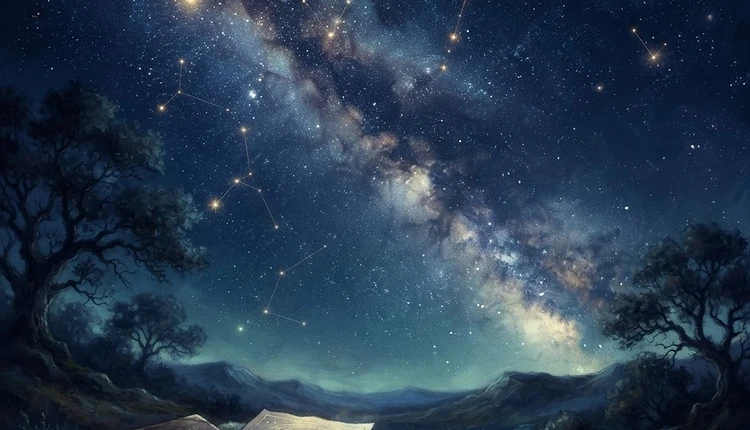
You start stargazing the same way every watcher of the sky in Scripture did — with nothing but your eyes, an open patch of sky, and the patience to let it happen. Step outside on a clear night, give your eyes twenty minutes to adjust to the dark, and look up. No telescope, no app, no training. The constellations, the planets, and the Psalms that go with them can all grow from that one simple beginning.
Do I Need a Telescope to Start Stargazing?
No — and this is worth saying plainly, because the single most common mistake beginners make is buying a telescope first. Your eyes are already a remarkable instrument. Dark-adapted, the human eye can pick out stars down to the sixth magnitude, the soft glow of the Andromeda galaxy, and the steady drift of satellites crossing overhead. A cheap telescope used in a bright backyard shows you less than your eyes will show you from a darker field.
Start with what you have. The only equipment worth adding in your first month is a paper star chart or a star map app, and — if you want to check a chart at night — a red flashlight. Red light lets you read without destroying the dark adaptation your eyes spent twenty minutes building. Ordinary white light resets that clock every time you look at it.
Where Should I Go to Watch the Stars?
Start in your own yard or a nearby park, facing away from streetlights and porch lights. You do not need wilderness; you need a patch of sky where the brightest lights are behind you. Even a modest reduction in glare brings dozens of fainter stars into view, and with them the shapes people have traced for thousands of years.
When you are ready for more, drive twenty to thirty minutes beyond the edge of town. The difference between a suburban sky and a rural one is not subtle — it is the difference between a few dozen stars and a few thousand, and the first time you see the Milky Way from a dark field, you will understand why the shepherds outside Bethlehem were awake and watching.
What Should I Learn to Find First?
Learn one constellation at a time, and only one. The night sky rewards patience and punishes ambition. A good first year looks something like this:
- Orion — the most recognizable constellation in the world. Face southeast on a winter evening and find three bright stars in a straight row: the belt. Hanging from the belt, a faint fuzzy patch is the Orion Nebula, a place where stars are being born right now. Job 38:31 asks who can loose the cords of Orion. Stand there some January night and feel the question.
- The Big Dipper and Polaris — the Dipper's two end stars point to the North Star, which barely moves all night. Once you can find Polaris, you always know which way is north, and the whole sky becomes easier to organize.
- The Summer Triangle — three very bright stars high overhead on summer evenings: Vega, Deneb, and Altair. Nearly overhead means no horizon landmarks needed; just lean back.
- The planets — Jupiter and Venus are often brighter than every star in the sky, and they do not twinkle. They wander along the same path the sun travels (the ecliptic), visiting the constellations of the Mazzaroth month by month.
An interactive star map helps enormously here — I built Scrolling the Heavens for exactly this moment, but even a printout from a library book works. The point is not the tool; the point is stepping outside with one shape in mind and finding it.
When Is the Best Time to Go Stargazing?
Any clear night works, but three timings make a difference. First, moon phase: the week around a new moon shows the most stars; a full moon washes out everything but the brightest few. Second, time of night: after 10 p.m. the sky is fully dark and late summer evenings are finally comfortable. Third, special events: meteor showers give a beginner a guaranteed reward. The Perseids every August 12–13 reliably produces a bright streak every minute or two from a dark site, no equipment, no skill. Put one on the calendar and you will never miss it again.
What Does the Bible Say About Watching the Heavens?
Scripture treats the sky as God's own broadcast: "The heavens declare the glory of God; the skies proclaim the work of his hands" (Psalm 19:1). When God finally answered Job out of the whirlwind, His first questions were not about ethics or history — they were astronomy questions. Who tied the Pleiades together? Who loosened the cords of Orion? Who leads out the constellations in their season? (Job 38:31–32).
The God who made the sky invites us to know it by name. Learning the constellations is not a distraction from faith; biblically, it is one of the oldest forms of paying attention to what He made and what He said.
How Do I Turn Stargazing Into a Devotional Practice?
Pair the sky with a Psalm, and go slowly. The pattern that has endured for three thousand years is simple: one patch of sky, one Psalm, one quiet chair or blanket.
- Psalm 8 — "When I consider your heavens, the work of your fingers, the moon and the stars, which you have set in place, what is mankind that you are mindful of them?" The best Psalm ever written for lying on your back.
- Psalm 19 — the heavens declaring, then the law of the Lord — sky above, Scripture in hand.
- Psalm 139 — "Where can I go from your Spirit?" Read under a sky full of stars, it stops being abstract.
I learned this the hard way, and young. At fifteen I was on a 32-foot sailboat running from New Jersey toward Bermuda when we sailed into a storm that lasted eleven days. In the middle of the Atlantic, at night, with the canvas snapping and the mast bent, I met the God who made the sea I was afraid of and the sky I could not see — and He was kinder than I expected. The storm ended. The stars came back. I have been watching both ever since. Whatever storm you are carrying, it is a very old experience to look up from the middle of it and find that the stars were there the whole time.
Bring a notebook. One line per night is enough — what you saw, what you read, what you heard. In a year you will have a log of the sky and a quiet record of your own soul.
Do I Eventually Need Binoculars or a Telescope?
Binoculars come first — a pair of 7x50s or 10x50s, which cost about the price of a nice dinner, will show you the moons of Jupiter, craters on the moon, the double cluster near Cassiopeia, and star fields inside the Milky Way. They are also easy to share with a child or a spouse, which a telescope squinting through an eyepiece is not.
A telescope can wait until you have found your way around the sky for a season or two. When the time comes, skip the department-store scopes and get a 6-inch Dobsonian — simple, sturdy, and more aperture per dollar than anything else. But in all honesty, some of the most faithful sky-watchers I know never bought one. The Psalms were written by people who owned nothing but a blanket.
The beginning is tonight. Pick one constellation — Orion in winter, the Big Dipper any season — step outside, give your eyes twenty minutes, and let the outskirts of His ways do what they did to Job. You will be back out tomorrow night. Everyone is.
Frequently Asked Questions About Christian Stargazing
Can you actually see stars from a city?
Yes, dozens of them. From a typical suburban yard you can see the fifty to a hundred brightest stars, which is enough for every constellation recommended here. Facing away from streetlights and choosing new-moon weeks makes a noticeable difference. For the full Milky Way, plan a short drive beyond the edge of town.
How long does it take to learn the constellations?
Learning one constellation per week, a beginner can navigate most of the prominent night sky within a single year. The shapes are fixed, so each one you learn is permanent. The core constellations — Orion, the Big Dipper, Cassiopeia, the Summer Triangle — are findable within the first month.
What Bible verses are best for stargazing?
Psalm 19:1 ("The heavens declare the glory of God"), Psalm 8:3–4 ("When I consider your heavens..."), Job 38:31–32 (God's questions about the Pleiades, Orion, and the Mazzaroth), Isaiah 40:26 ("Lift up your eyes on high and see: who created these? He who brings out their host by number"), and Psalm 136:7–9 are the classic sky-watching passages.
Do Christians practice stargazing or astronomy?
Yes — Scripture repeatedly presents the sky as something God made for humans to observe, name, and wonder at. God Himself highlights the constellations in Job 38, and Psalm 19 pairs the heavens declaring God's glory directly with meditation on His word. Christian stargazing simply treats the night sky as an invitation to worship the Maker rather than the made.
What is the one thing I should do first?
Step outside tonight, look up, and find one bright pattern. Everything else — the star map, the binoculars, the Psalms, the notebook — grows naturally from that first honest look.