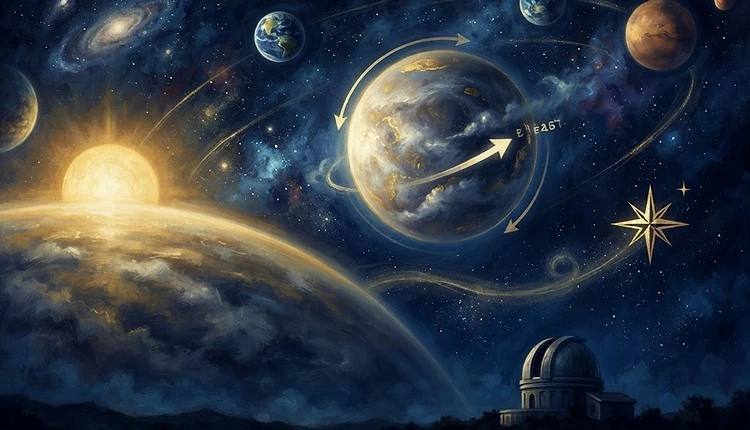
Does Venus really spin backwards? Yes. It is the strangest simple fact in the solar system: the planet we call the Morning Star, the brightest light in our sky after the sun and the moon, turns the opposite way. The sun spins counterclockwise seen from above the north pole, and all eight planets orbit that way. Nearly every planet rotates that way too — every one except Venus and Uranus. Uranus breaks the pattern by being tipped almost completely on its side; Venus breaks it by simply turning the other way, clockwise, backwards.
Does Venus Really Spin Backwards?
Yes — Venus has what astronomers call retrograde rotation. Stand on Venus and the sun rises in the west, climbs slowly across the sky for the better part of two months, and sets in the east. Everything about the turn is backwards, and everything about it is slow.
Venus takes 243 Earth days to rotate once on its axis. It takes only 225 Earth days to orbit the sun. That means a day on Venus is longer than its year — the only planet in the solar system that can say so. And because the rotation is backwards, the combined effect produces a single sunrise-to-sunrise cycle about 117 Earth days long. The slowest morning in the solar system.
Does Venus Spin the Opposite Way of Earth?
Yes. Earth rotates counterclockwise as seen from above the north pole, like nearly all the planets. Venus orbits the sun the same direction everyone else does — counterclockwise — but its spin is reversed. Uranus is the only other oddball, and it solves the problem differently: Uranus is tipped almost completely on its side, 98 degrees, rolling around the sun like a ball rather than turned over backwards.
Odd is not rare in God's house. No two of the eight planets turn alike, and the same hands fitted every one of them.
Why Does Venus Spin Backwards?
This is the honest part: scientists still are not certain. NASA and planetary researchers weigh three leading explanations, and the truth may be a combination of them.
- A giant impact early in its history. The oldest explanation: a body close to Venus's own size struck the young planet and reversed or flipped its rotation. The same kind of collision is the standard story for Uranus's sideways tilt. It is plausible; it may simply be unprovable, so long after the fact.
- Atmospheric tides. The sun's gravity pulls on Venus's crushing carbon-dioxide atmosphere — 90 times the pressure of Earth's — and the resulting tides, acting steadily over the ages, may have worked like a brake and then a ratchet, first slowing the planet's spin and eventually helping to reverse it. Radar comparisons from NASA's Magellan mission suggest Venus's rotation is still slowing, which supports a tidal story.
- Core and mantle friction. Heat sloshing between Venus's hot core and its rocky mantle, drawn out over the planet's interior history, may have torqued the spin down and around. Some simulations show a planet starting prograde and ending retrograde with no collision at all.
All three stories share one honest conclusion: whatever happened, it happened gradually — and no one was there to watch.
What Would You See Standing on Venus?
You would see the sun rise in the west — the only place in the solar system where it does — and you would wait a long time for it. From sunrise to sunset on Venus takes about 58 and a half Earth days. Then darkness, then another sunrise in the west, 117 days after the last one began. A Venusian year is only 1.6 Venusian days long.
Not that you would see it. Venus's clouds never part; the surface is a furnace at 864 degrees Fahrenheit, hot enough to melt lead, under skies that crush like the pressure 3,000 feet under the ocean. But the sun still rises in the west, whether anyone watches it or not.
What the Backwards Planet Says
Here is the quiet thing about Venus: it keeps its appointment. Retrograde or not, slow or not, it arrives at the same place in our sky it always has — the first star of evening, the last star of morning, the herald of the dawn. The direction of its spin changes none of that.
The Bible never tells us which way Venus rotates; it tells us what the sky is for. "The heavens declare the glory of God" (Psalm 19:1), and Venus declares it backwards.
Scripture does hold out a title worth thinking about. The risen Christ calls Himself "the bright morning star" (Revelation 22:16) — the same title the ancients gave to Venus at dawn, the star that outshines everything before the sun arrives. When Venus rises in your eastern sky before dawn this month, remember the order: the star is not the Savior; the star is the herald pointing to Him.
And the backwards planet itself preaches a small, kind word about variety in God's house: "The sun has one kind of splendor, the moon another and the stars another; and star differs from star in splendor" (1 Corinthians 15:41). One planet turns the other way entirely, and the heavens are still very good.
The Kingdom That Turns the Other Way
One more thing the backwards planet can say, and it may be the best of them.
Every kingdom of this world turns one way — up. Bigger, faster, louder, higher; the ladder never changes. Jesus described a kingdom that turns the other way entirely: "Whoever would be great among you must be your servant... whoever humbles himself will be exalted" (Matthew 20:26; 23:12). The way up, in the kingdom of God, is down.
Venus is the brightest light in our sky precisely because it will not run with the crowd. There may be a parable in that: in God's house, the one that turns the other way is not diminished for it. It outshines the rest.
And a gentle word about science, because science is a gift — every honest measurement of the heavens is a kind of reverence, and this article has leaned on the scientists' work gladly. But science is limited by design. It can tell us how Venus spins. It cannot tell us what the spinning means, or who we are before it, or why there is anything at all. When the measurements end, the oldest question is still standing: "Where were you when I laid the foundation of the earth?" (Job 38:4). Science traces the spin; only faith hears the Voice behind it. That is not faith against science — it is faith simply going where science cannot. And at the last, the final word over every kingdom is not a measurement. It is a Person.
FAQ
Does Venus spin clockwise or counterclockwise?
Clockwise — the opposite of Earth and nearly every other planet. Astronomers call it retrograde rotation. Only Uranus breaks the pattern too, and it breaks it by being on its side rather than backwards.
Why does Venus spin backwards, according to NASA?
NASA and planetary scientists weigh a giant impact, atmospheric tides slowing and reversing the spin over the ages, and core-mantle friction. There is no settled answer yet; the honest position is that Venus's backwards rotation remains an open question.
Does the sun rise in the west on Venus?
Yes. Because Venus rotates clockwise, its sun rises in the west and sets in the east, with a full day-night cycle lasting about 117 Earth days.
Is Venus the only planet that spins backwards?
Nearly. Venus is the only planet that rotates plainly backwards — clockwise instead of counterclockwise. Uranus is the other oddball, but it breaks the pattern differently: tilted 98 degrees onto its side, effectively rolling around the sun rather than spinning upright.
Is a day on Venus longer than its year?
Yes — 243 Earth days to turn once, 225 Earth days to orbit the sun. Venus is the only planet in the solar system whose day outlasts its year.
Sources: NASA Science, NASA Magellan mission updates, ESA Venus Express findings on atmospheric super-rotation.