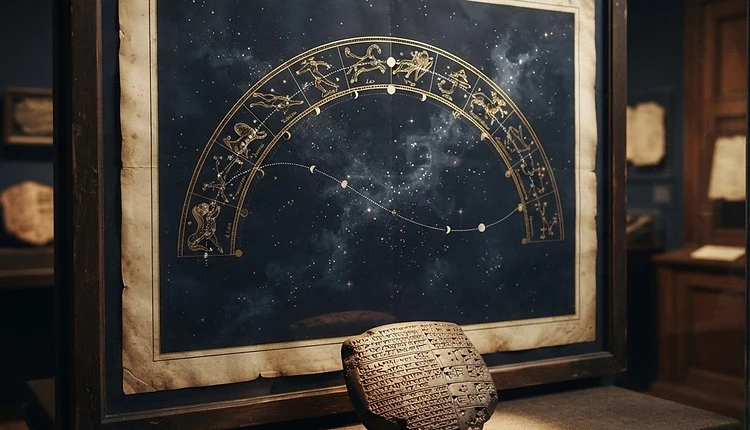
Many people assume the zodiac is an ancient Greek invention, complete with its familiar animal figures and twelve equal signs. The name itself is indeed Greek, but the underlying celestial system is older—and it may be precisely what Scripture calls the Mazzaroth.
The English word “zodiac” comes from the Greek zōdiakos kyklos, literally “the circle of little animals.” It is formed from zōidion, a diminutive of zōion (“animal”). The Greeks used the term for the band of constellations along the ecliptic, the apparent path of the sun, moon, and planets. Because most of these figures were animals or animal-like hybrids, the name stuck. It entered Latin as zodiacus and later reached English through Old French in the late Middle Ages.
Yet the Greeks did not invent the system. They inherited and refined a Babylonian framework. Centuries earlier, Mesopotamian astronomers had carefully mapped the stars through which the moon, sun, and planets travel. In the classic astronomical text MUL.APIN (compiled around 1000 BCE or earlier), these are described as “the stars who stand in the path of the Moon, through whose region the Moon during a month passes repeatedly and keeps touching them.” This list of roughly seventeen or eighteen constellations includes clear forerunners of the later zodiacal figures: the Stars (Pleiades), the Bull of Heaven, the Great Twins, the Crab, the Lion, the Furrow, the Scales, the Scorpion, Pabilsag, the Goat-fish, and others.
By the fifth century BCE, Babylonian scribes had formalized this path into a uniform mathematical system: twelve equal signs of thirty degrees each, totaling 360 degrees. They named the signs after the constellations lying within them—the Hired Man, the Stars, the Twins, the Crab, the Lion, the Furrow, the Scales, the Scorpion, Pabilsag, the Goat-fish, the Great One, and the Tails. These are the direct ancestors of Aries through Pisces. The Babylonians treated the arrangement as a practical coordinate system for tracking celestial motion and seasonal change, not as a circle of animals per se. That descriptive label came later with the Greeks.
This brings us to Scripture. In Job 38:32, God asks:
“Canst thou bring forth Mazzaroth in his season? or canst thou guide Arcturus with his sons?” (KJV)
Mazzaroth (Hebrew מַזָּרוֹת) is a hapax legomenon—it appears only here. Its precise meaning is debated, but the majority of interpreters and lexical authorities connect it with the constellations, and frequently with the zodiacal signs or the band of stations through which the luminaries pass. The King James margin even notes “the twelve signs.” A closely related term, Mazzaloth (מַזָּלוֹת), appears in 2 Kings 23:5 in the context of the starry host that Josiah’s reforms removed from worship. Later Hebrew usage of mazzal came to mean a zodiac sign and, by extension, fortune (hence the expression mazel tov).
Scholars often link the word to an Akkadian root meaning “station” or “position” of a heavenly body (manzaltu / mazaltu). This matches the Babylonian description of the path of the Moon and the successive stations the sun and planets occupy. In the poetic structure of Job 38, Mazzaroth stands alongside other named celestial groups—the Pleiades (Kimah), Orion (Kesil), and the Bear (‘Ayish)—as part of God’s challenge to Job. The point is not to encourage star-gazing for omens, but to highlight the orderly, seasonal progression of the heavens that only the Creator can bring forth and guide.
Genesis 1:14 already establishes the theological framework: the lights in the expanse are “for signs and for seasons, and for days and years.” The Mazzaroth fits naturally within this purpose—the visible markers of God’s appointed times. The same God who set the sun, moon, and stars in their courses (Psalm 19; Isaiah 40:26) is the one who brings forth Mazzaroth in its season. What the Babylonians observed as the path of the Moon, and what the Greeks later named the circle of little animals, Scripture presents as part of the ordered cosmos under divine sovereignty.
This does not endorse astrology. The Bible consistently forbids divination and the worship of the host of heaven (Deuteronomy 4:19; 2 Kings 23:5; Isaiah 47:13–14). The constellations declare God’s glory (Psalm 19:1); they do not determine human destiny. The seasonal regularity of the Mazzaroth points instead to the faithfulness of the Creator who “brings out their host by number” and calls them all by name (Isaiah 40:26). In a world that still looks to the stars for guidance, the biblical testimony redirects our gaze upward to the One who made them and who, in the fullness of time, entered history as the true Light.
The next time you hear the word “zodiac,” remember its layers of history: a Greek name for an older Babylonian path, and very likely the same celestial system the book of Job calls Mazzaroth. The heavens still declare the work of God’s hands—not as a source of fate, but as a witness to His wisdom, power, and steadfast order.